A fine WordPress.com site

Archive for the ‘Uncategorized’ Category

Death as a Fine Art

Bartender’s Guide to Murder Book 5

Chapter One

I THINK WE HAVE A SITUATION

The gingerbread man was dead in the lobby.

This was the ultimate surprise in an afternoon of unexpected events. I honestly thought we’d already awarded shock of the year, but by anyone’s account, the demise of Noel Schlessinger topped them all.

Here’s how it went down.

It was a crisp Friday afternoon in mid-November and I was in the Battened Hatch, the Scottish pub attached to the inn misleadingly named MacTavish’s Seaside Cottages Misleading because there is no sea and there are no cottages. There was, however, a MacTavish, scion of the family who’d run the inn for over one hundred years. The inn itself is magnificent and woodsy and one-of-a-kind. It pours out of the hockey-rink-sized lobby in three directions, hallways meandering the hills of Tranquility, New York, an Adirondack town that had twice hosted the Winter Olympics.

Though the cavernous lobby is made of dark wood, light floods it both from skylights and a back wall of floor-to-ceiling windows, which provide a panoramic view of a small lake encircled by old-growth forest. A huge statue of downhill skiers, seemingly whooshing from one of the skylights, bestows upon the lobby a feeling of movement and excitement. Near the statue stood a maroon circular sofa, known in bygone days as a banquette settee. Its center pillar anchored a ring of seats facing outwards, perilously close to the skiers’ path— giving the impression that unwary loungers could easily be whacked by the skiers.

We’ll get back to that settee.

On the far side of the lobby are two doors. One is chrome and glass, usually set wide open, welcoming all comers. It leads into a restaurant named Pepper’s, a cheery, pricy, upscale place that overlooks the lake and caters to the tourist trade.

To the right of this entrance is an undistinguished wooden door. The small, painted pub sign above it features a masted sailing ship cutting through waves above the words That Ship Has Sailed.

Through that door is a dark hallway that smells of wood polish and leather. It is the only working time machine I know of. At least, it functions as one for me, leading back into a past that doesn’t normally exist; a past in which mahogany bars were lined with larger-than-life characters sipping extraordinary concoctions, alcoholic or not, created by the local barkeep and mixologist.

In this case, that would be me.

Those in the know call the pub by its local nickname, The Battened Hatch.

That’s where I stood that autumn afternoon, along with Marta Layton, my assistant manager and bartender-in-training. While teal-colored hair came and went from everyone else’s fashion statements, Marta’s highlights stayed firm.

In front of the bar sat a blonde woman.

She had said hello to me and I answered in kind as she slipped onto a comfortable, cushioned bar chair. As she sat, so did a large gentleman—in his early sixties was my best guess. He had a face with animated features highlighted by male pattern baldness, and the squarest forehead I’d ever seen. He wore a tan jacket. “Hey,” he said, in a way that implied he had now arrived and any other patrons or conversations could wait. “Hey. Gimme a hot chocolate and bourbon.”

As he spoke, the door from the kitchen swung open behind me and Stormie Edwards, Chef Angelica Dormer’s sous chef, bounced through. “Avalon!” she said, “Have you heard who’s here—”

Stormie’s eyes landed on the woman in front of me and she screeched to a halt. “Um,” she pivoted, “the first contestant has arrived. For the gingerbread house competition. It’s real, and it’s happening!”

As she turned back around, she gave a silent scream which could be seen only by Marta and myself. It was clearly referencing said woman.

“When does the competition begin?” I asked, partly to help bolster her flimsy cover story, partly to torture her by not allowing her to escape her proximity to the actor whose fame had her hobbled, partly to postpone my own interaction with said movie star.

“The contestants arrive today and tomorrow. Filming starts on Saturday night.”

“Filming?”

“Well, technically ‘digitally recording’ for the network. Yes, it’s not like the National Gingerbread Competition at the Grove Park Inn in North Carolina. There, anyone can enter and the gingerbread creations arrive fully built. Ours only has half a dozen pre-selected competitors, and they have to put the structures together here. They also have to incorporate some gingerbread they’ve cooked here on site. It’s all being filmed—recorded–for the Delicious Network.”

“They have to cook here? Where?”

Stormie nodded back toward the door she’d just come through.

“Angelica’s kitchen?” I asked. “Strangers cooking in Chef Angelica’s kitchen?”

“That’s why it’s a good thing she’s away at the Brewster Competition, isn’t it?”

“Chef doesn’t know?”

“The local health inspector has signed off on it,” she said quietly. “They’ll use it in one-hour segments, overnight on Saturday. It will be pristine by Sunday morning.”

As I continued to stare at her, she protested, “Mr. MacTavish is thrilled, you know that. Think of all the publicity it’s bringing! And the hotel rooms will be full of contestants and television crew.”

“This was your doing?” Truthfully, it was pretty impressive. And, as she said, Chef Angelica was away. I wondered sometimes if Sous Chef Stormie was a better fit at Pepper’s than Chef Angelica. Did Stormie sometimes wonder that, too?

“That’s why I’m here, Missy,” said Mr. Hot-Chocolate-and-Bourbon. “I love to follow gingerbread competitions this time of year. They’re so creative—and I love the drinks that come with them!”

I turned back around to the patron who had dared rename me Missy.

Okay, okay, yes. I was aware there was a Welcome to Gingerbread Land banner outside, and cards with the times of events and listings of gingerbread-themed drinks.[Sd1]

Which didn’t mean I was ready for it to begin. I knew the contest had to be over before Thanksgiving so the houses could be on display starting Black Friday and running through the holiday season as a tourist draw.

That didn’t mean I had hot chocolate at the ready. In my mind, that came after Thanksgiving, as we entered the Christmas/ski season. They weren’t really planning to get this competition edited and running before Christmas, were they?

“You follow gingerbread competitions?” I asked my patron.

“Yes, indeed. I’m proudly known as the Gingerbread Man in some circles.”

“How are you known in other circles?” I asked.

“Noel. Noel Schlessinger.” I could detect a Long Island childhood in his accent. He reached out a beefy hand and gave mine a strong shake.

As we’d been discussing the cooking competition, staff and guests from around the hotel had been peeking in to get a gander at our famous guest, quietly seated next to Mr. Gingerbread. Some of them nonchalantly found tables, others just piled into each other, Keystone-Cop style, at the end of the entry hall.

“Can you go into the kitchen and see what the hot chocolate situation is?” I asked Marta.

“Mom?” she whispered, referencing my earlier address of the celebrity seated before us. “You said, ‘Hi, Mom?’”

I hoped she hadn’t heard, or noticed, my shocked greeting. I’d hoped–and continued acting as if—no one did. Apparently, I was not so lucky.

I turned her around and shoved her through the swinging kitchen door.

“Coming right up,” I said to Noel.

Then, with no further excuses for stalling, I turned to the A-list actor before me.

“Can I get you a drink?” I asked. “Or would you like to go somewhere and talk?”

“Sure,” she said. “The second one.”

“Back this way,” I said.

She stood and Noel Schlessinger realized for the first time who he’d been seated next to. His jaw dropped. He sputtered, trying to talk, reaching out, but she was already beyond his grasp.

I led the way to the back wood-paneled hall. Did I mention I was wearing a cast? It was a walking cast and I told myself I was good at walking in it, but still, if you were trying to nonchalantly stride somewhere, it added its challenges.

I hobbled as quickly as I could.

Across from the restrooms was the bar’s storeroom. No one had followed us—yet. Everyone in the bar was surely thinking of a reason they had to use the restroom. We had approximately ten seconds to disappear, by my reckoning.

I unlocked the storeroom door and we bolted inside, shutting and relocking it behind us. Not turning on the lights, I led us towards the back of the room, to keep our voices out of earshot. The storeroom is large, with two rows of shelving in the middle and a heavier version against one wall. A refrigerated unit nestles across the other.

The room smelled faintly of fake lavender from a floor-cleaning product. There is no back window to allow in sunbeams and dust, only semi-darkness softened by the green letters of the exit sign and a light-sensitive nightlight I plugged in for occasions such as this.

In fact, I’ve had so many private conversations in the storeroom that in that moment, I decided to get a couple of chairs, a lamp and a tufted rug. Beige, probably.

Dear God, I was thinking anything not to have to deal with the chiseled perfection in front of me.

“Avalon, what happened?” she nodded to the cast.

“Why are you here?” I asked.

“It’s good to see you, too,” said Anna Nash. “What happened?”

We looked at each other. I remembered almost dying once and being sorry I hadn’t made things right with her. I was so brimming with emotions—every single one ever invented—that their only escape route was a single tear, a warm streak down my cheek.

“I jumped off a building,” I said. “It was on fire.”

She pulled me to her. I didn’t have the strength to fight her embrace. Even though I was in my late twenties, fitting into the space of my mother’s arms, the familiar scent, the soft warmth of her sweater, the safety and danger promised there, I wept.

I am not an emotional person. I’ve been through a heck of a lot without losing my cool. Ask Mike Spaulding of the state police.

Mom always makes me lose my cool.[Sd2]

“Can you tell me what this is about?” she asked, referencing my outburst.

I shook my head. “Too much to go into.”

She nodded. We moved to stand in the back corner by the nightlight so we could see each other. She wore jeans and a beige sweater. Her natural blonde hair was a shade lighter than mine, brushing against her shoulders, molding her into a Nordic warrior. She worked out faithfully—she had to, it was part of the job. Her muscles were honed but not sharp. She wasn’t tiny and elfin, she was statuesque, five eight, maybe? I’d never asked. But she gave off an aura which made her seem larger than life.

There is a ditty amongst the Nordic sisterhood which starts:

I am my mother’s savage daughter,

The one who runs barefoot cursing sharp stones.

I am my mother’s savage daughter,

I will not cut my hair, I will not lower my voice.

Those lyrics alone bring me strength in difficult situations. The thing is, there is nothing savage about my mother. She is kind. She is brilliant and brilliantly talented. She is funny, compassionate, willing to wade in to help in any given situation.

She is perfect.

Which makes it impossible to be furious with her, as, by definition, the problem has to be someone else’s. Problems are for imperfect people.

Like me.

I wiped my cheeks with the back of my hands.

“I’m sorry we didn’t get to spend more time together at your mormor’s funeral,” she said.

“Me, too.”

“There’s something I need to talk to you about, to do with changes in the family. Is there a time that would be good? After work, maybe?”

“I’m not closing tonight. I’ve promised to work a show at a local art gallery.”

“After that? What time will you be done?”

“The show is seven to nine. I’ll likely be done by nine-thirty. Is that too late? Will you still be here?”

“I’m here to talk to you,” she said.

I knew what I should say next. I should offer her the guest room in my cottage. I should invite her into my life. The life I’d worked so hard to build here. The life where I was Avalon Nash, bartender and friend, not Avalon Nash, daughter of Anna Fucking Nash.

Not inviting her was quite obviously keeping her at arm’s length. Worse, it amounted to throwing her to the public and the adoring fans.

“Do you have a place to stay?” I finally said.

“Yes. I have a room reservation here. I’m checking in under Anna Karenina,” she smiled. She loved to borrow the monikers of famous Annas when she stayed in hotels. “But you have my number. We can text.”

“I do,” I said. “Will you be all right? People seem to have discovered you. Rise O’Connor was just here,” I said, referencing a childhood friend who was now a well-known actor. “He had some challenges with people stalking him.”

“Rise, really? How is the kid?”

“Complicated. I’ll fill you in later.”

“Okay. And don’t worry. I can handle myself. When you act normal, people usually settle down.”

Good luck with that, I thought.

“Text me when you’re done,” she said. “Quaint town. Think I’ll look around.”

“Okay. But Mom, be careful.”

“I promise.”

“Should I see if the coast is clear?” I asked, heading for the door.

“Naw. It’s usually best to walk through and be gone before they realize you’re there.”

She put her hand on the doorknob. We nodded to each other. She opened it, stepped out – head high, smile on her face – and walked resolutely toward the exit door to the pub.

It worked. Everyone she passed stopped, as if turned to stone in her wake. And then she was gone.

Marta was at the bar, overseeing the influx of drink orders. I stepped back to help her.

“Mom?” she said again. “Hi, Mom?”

“Now you know,” I said.

The next few hours flew by, as orders continued even though the unexpected guest had departed.

Things finally quieted down just before supper time, which was when Sous Chef Stormie reappeared from the kitchen behind me. She pulled me back away from the bar.

“I think we have a situation,” she said.

“Oh?”

“Mr. Schlessinger, the guy who was sitting here, who called himself the Gingerbread Man? I saw him sitting in the lobby and I went to sit next to him to ask if he would enjoy being interviewed for the Delicious Network show.”

“And?”

“He wouldn’t answer me.”

“Did he say maybe?”

“No, I mean, not at all. I think…I think he’s dead.”

I THINK WE HAVE A SITUATION

Ingredients

Cocktail (batch recipe)

3 qt saucepan

6 cups of milk of your choice (preferably whole milk)

1 cup semi-sweet chocolate chips

1 tablespoon of honey

1 vanilla bean

6 oz Bourbon (your choice); set aside

Raw honeycomb or fresh loose honey for garnish

4 Cocktail Mugs

Whipped crème

1 large mixing bowl

3 cups of heavy whipping crème

3 tablespoons of loose honey

Remainder of vanilla bean seeds

Method

Hot Chocolate

Add milk to sauce pan and stir until you have a gentle boil, continue stirring while adding the honey and semi-sweet chocolate chips. Slice vanilla bean down the center and scrape half of the seeds out and put into milk mixture in saucepan. Retain the rest for whipped crème. Continue to stir until all ingredients are mixed and then turn the heat down to low and let simmer for about 5 minutes stirring occasionally. Turn hot chocolate mixture off.

Whipped cream

Add all ingredients to large mixing bowl and whip (by hand or blender) until you havesoft fluffy peaks.

Cocktail

Add 1 1⁄2 oz of Bourbon to each cocktail mug, ladle hot chocolate mixture into each mug, leaving a space at the top for whipped cream. Add a few nice large dollops of whipped cream to top of hot chocolate bourbon mixture and finish with a small piece of fresh honeycomb or drizzle some fresh lose honey on top of crème.

Keep reading on Kindle! https://www.amazon.com/Death-Fine-Art-Mystery-Bartenders-ebook/dp/B0DRW9GRL2/ref=sr_1_1? crid=174RFR1VMDQBZ&dib=eyJ2IjoiMSJ9.6yH2Znw05GgQu4585cIuzkWSRBfhkmQXmv50tUkaqJ1jYuCP8kfZ-rqe-Xfty0Lh.h9lSCDi9ZitIlGxtc4t0fqXFAr5ulCXoleVBksVN9sU&dib_tag=se&keywords=death+as+a+fine+art+linnea&qid=1736375561&sprefix=%2Caps%2C145&sr=8-1

Or support Lake Placid’s Independent Bookstore and order a paper copy! https://thebookstoreplus.com/browse/filter/t/death%20as%20a%20fine%20art/k/keyword

Sharon Linnéa is the author of the bestselling Eden Thrillers, Chasing Eden, Beyond Eden, Treasure of Eden and Plagues of Eden with Army Chaplain (Col) B.K.Sherer. She has written award-winning biographies of Raoul Wallenberg, the young Swedish architect who saved over 150,000 Jews in World War II and of Hawaii’s Princess Kaiulani. She started the Bartender’s Guide to Murder series after falling in love with the Olympic mountain town of Lake Placid, New York.
Jamielynn Brydalski is an internationally award-winning mixologist. She travels the world but met Sharon while bartending in Lake Placid, New York. More than 20 of her recipes are featured in the book.
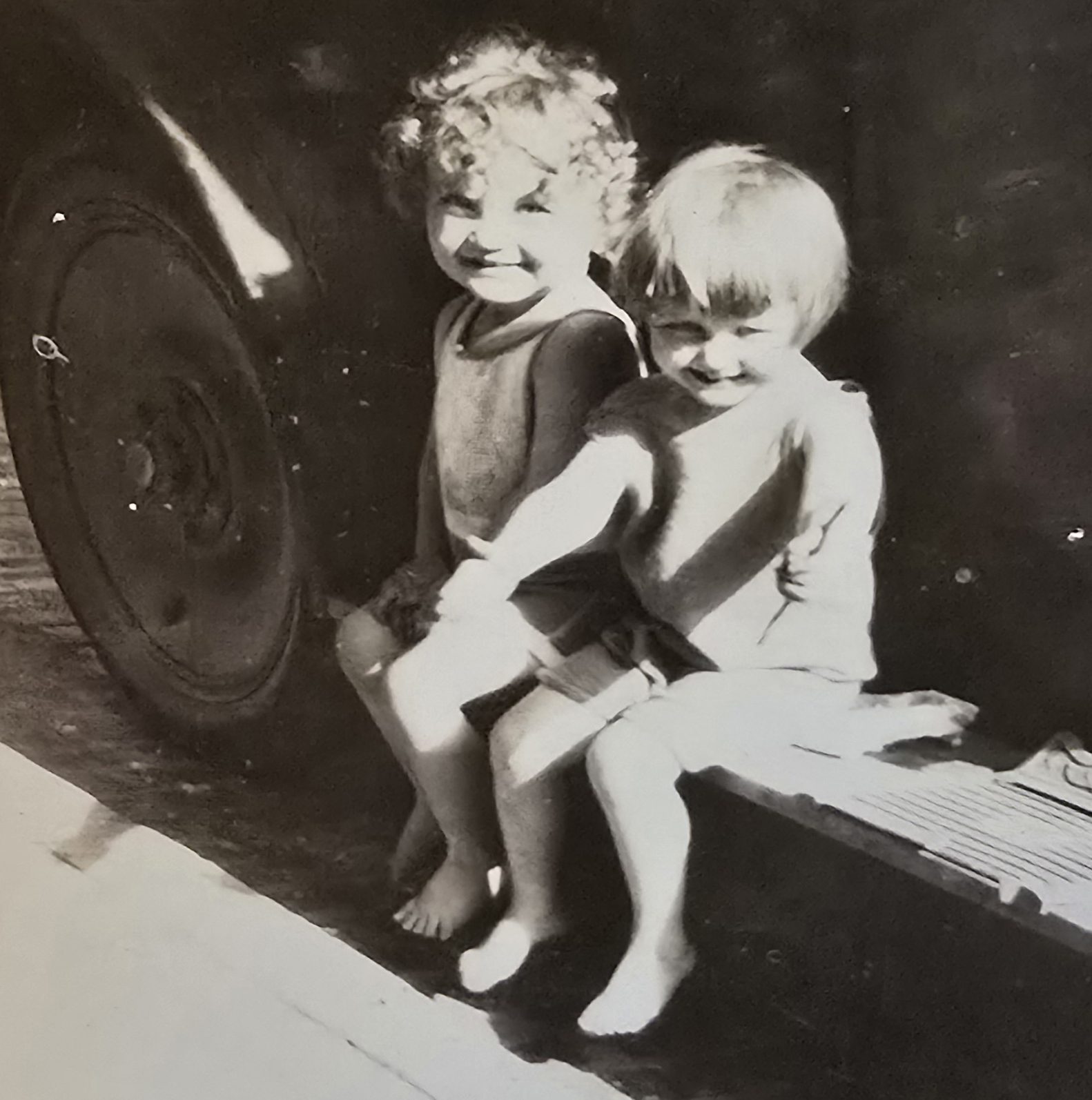
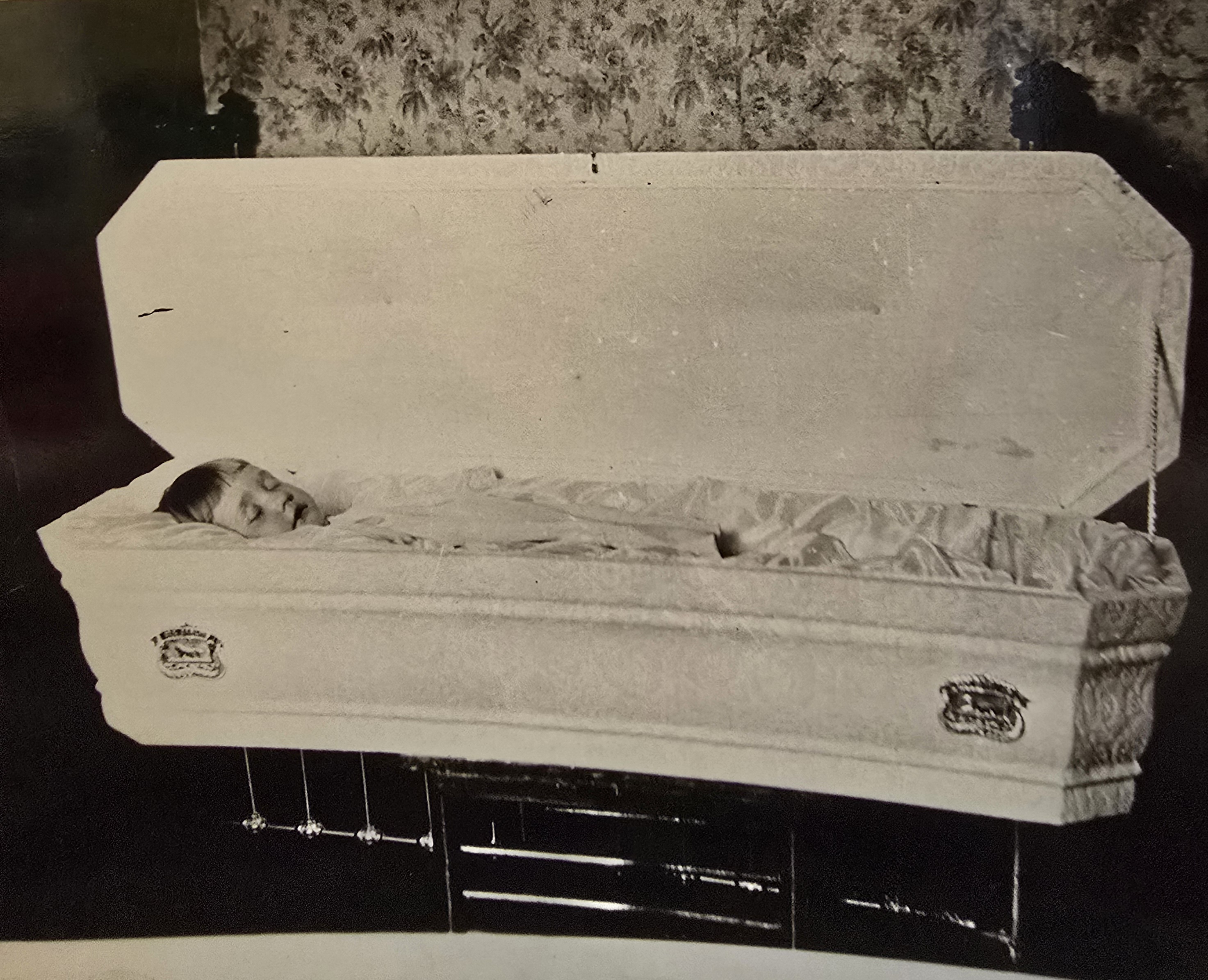
So Small to Go So Far Alone…

August 30, 1929

Dearest Mother,

Four days have passed since Evelyn left us—four days of agonized grief and yet this is only the beginning of our tears for we miss her more and more. It is terrible to be alone here at home but the Health Department forces me to, until they are satisfied that I won’t spread the disease.

               I suppose you want the details of our Darling’s death—She was getting better, her throat was almost well but the diphtheria had so poisoned her system that she could not keep any food down; besides, the poison weakened her heart. The doctor said the day she died he was sure she would pull through even though I had been worried sick because her hands and feet were like ice. Yet she did not complain and that afternoon she was able to keep some water down. I will never forget that morning I pulled the day bed in front of the window and laid her in the sunshine. As I stood gazing at her, the sunshine on her golden head seemed to form a perfect halo and her face looked so heavenly sweet. Toward evening she vomited and became very weak and as I was giving her treatments she became weaker so I called the doctor back but he did not believe there was any danger. He told me however what to do in case she began sinking.

               For a while she was extremely restless, then she yawned comfortably and I was so glad that she was going to rest. For days she had only mumbled when she spoke but then she spoke quite plainly, “Mamma, I want you,” then “stay with me” and “Don’t go away.” I bent over her and reassured her and asked if she was “Mother’s girl baby” and she nodded and smiled sweetly. I asked her, “Do you love Mother?” and she smiled and murmured “yes.” I sat by her bed trying to keep her warm with the electric pad and holding her hands. Suddenly without any warning she stiffened up as in a spasm and the next second her life had fled before I could do a thing. Her little heart was suddenly overcome by the poison in her system.

First I felt terrible that the doctor had not come but now I realize that he could not have done any more than I did and at most her life would have been prolonged a couple of hours. We got a doctor in a few minutes and he said there was nothing to do but I worked for hours trying to bring back a spark of life. Arthur was with me when she died but he became hysterical. What we went through the rest of that night God only knows. We called up Bensons but of course we were still quarantined so no visitors were allowed. However, Harold and Russel drove in and stayed in the hall awhile.

Because of the diphtheria we were not allowed a regular funeral. Only the closest relatives were permitted to get a glimpse of her and the flowers could not be brought in but had to be in the basement until taken to the cemetery. The undertaker was a friend of Arthur’s family and made things as easy as possible. Evelyn’s little body could not even be brought into the front room. She lay on her bed wrapped in a sheet until the day of the funeral when she was placed in her little casket. The sheet was supposed to cover her face and be sealed after the embalming but he left it so we could look at her when we wished.

Arthur and I could hardly bring ourselves to leave her a minute. I made her last little dress myself, all by hand because I could not bear to have anyone else make it. Oh how bitter it seemed that it was the last garment I could ever make for my beloved little girl. So many people could not understand how I was able to do it but it was a relief to be doing something as one gets too weak to walk the floor all night and day.

I sat by her crib as if she were sleeping and made it just as it would have pleased her. It was made of pale pink crepe de chine in your favorite style and it was trimmed In rosebuds. It fit her perfectly and looked too beautiful for words.

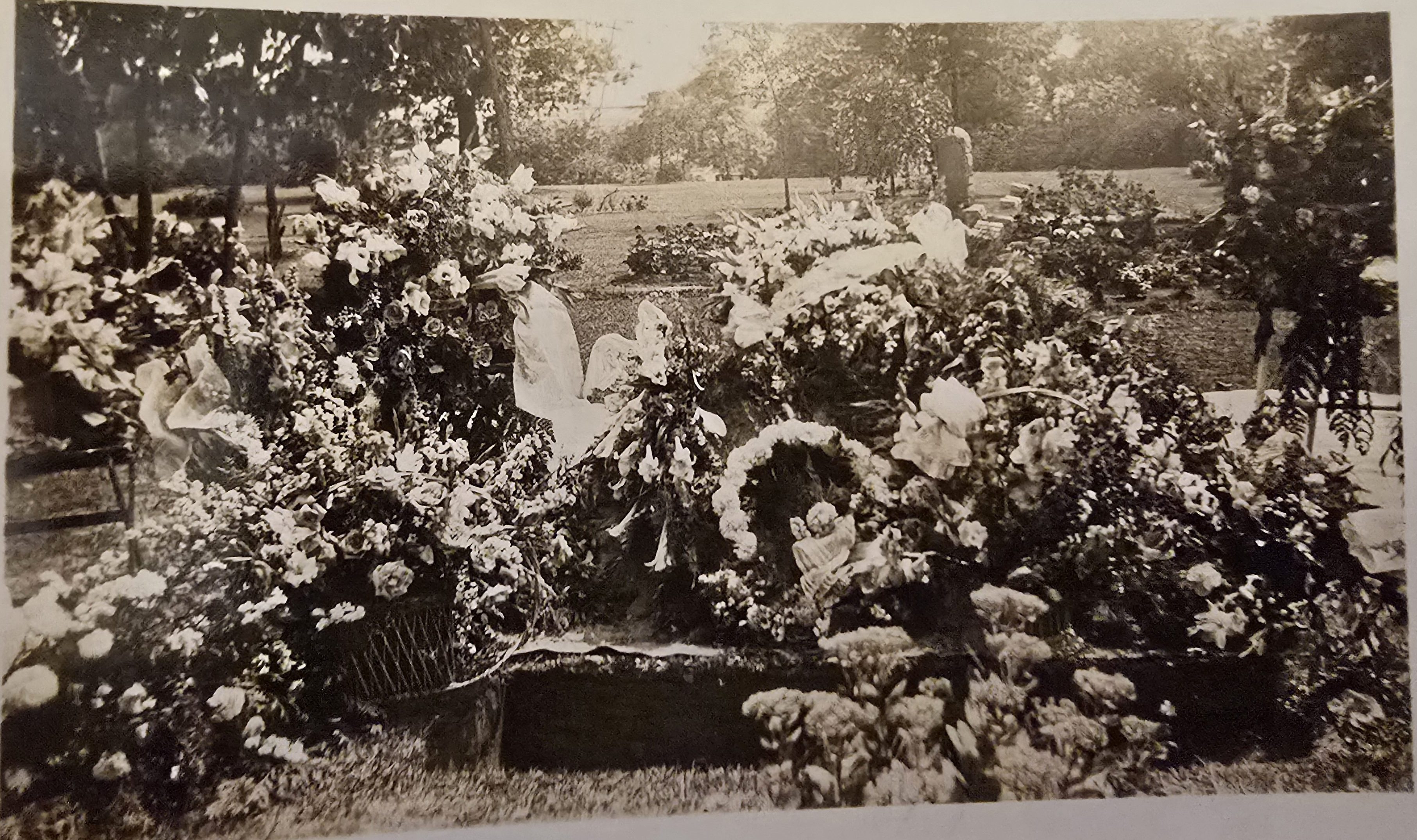
Pastor Hamlin of Berwyn, another friend of the family, held such a comforting and soul-satisfying service at the cemetery. Two ladies sang, “Meet Me There” and “Life Up Your Eyes.” That was our baby’s last lullaby.

We took pictures of the funeral and when I get them I will send them. How is Dad and the rest of the family? Write soon.

Your heartbroken

Alice

Evening Reveries

Tonight I heard a mother call another child

Who bore my darling’s name

And my heart crumbled.

Evenings like this we used to sit before the fire

Her curly head within the circle of my arm,

A cold rain beating on the window panes.

It beats again tonight and I am all alone.

She was so warm and sweet

All pink and blue and gold

Strange that I could produce such loveliness

Such exquisite fruition of my girlhood dreams.

She was so young that she had never learned to dream.

There are no dreams in heaven,

Only dreams’ fulfillment.

She seemed so small to go so far alone—

She was only seven,

And he whole world was still

Her mother and her playmates

And a foolish little dog.

She took such pride in her new shoes,

And now she wears winged sandals on her feet!

How has she changed, now five years in heaven?

Her beauty has begun to blossom,

Her eyes grown deep

From looking on the wonder of His face.

She knows no tears, nor loneliness,

And sorrow never touched her brow.

Little daughter grown so wise!

She would not have me sit alone before my fire.

And eat the bitter bread of grief.

A little time, my Very Dear,

A few more sunsets fading in the west,

And then, as sweetly as before,

Your curly head within the circle of my arm,

And you and I together looking on His face.

–Alice Carlson

Death from Beyond

start reading chapter one

Bartender’s Guide to Murder book 4

Chapter 1

All Hallows’ Eve Eve

She sat down at the bar at 9:14 PM on the last Friday in October, a tall woman, with large hazel eyes, long nose, chiseled chin, paperwhite skin, and thick black hair. She wore an ecru shirt topped by an olive green jacket.

            “I need some liquid courage,” she said.

            “You’ve come to the right place.” I plunked down our Scary October Cocktail menu.

            “The problem is, I can’t drink alcohol. Doesn’t mix with my meds.”

            “Got you covered.” I turned over the cocktail menu to the mocktail side. The list was equally as long. “I’m afraid you’ll have to provide the courage yourself.”

            “I’ll try the Fall Fiesta,” she said, choosing a cider-based libation.

            “Coming up.”

It was Halloween weekend and the Battened Hatch was crazy busy. The Adirondack town of Tranquility went all-out for the holiday; in fact, it had been named Best Halloween Town by an upscale travel magazine. Folks flooded in. The Visitors Bureau concentrated on events for kids—parades, daytime trick or treating on Main Street, scavenger hunts. If you wanted witchy doings, you still had to head for Salem, Massachusetts. Or parties here to which I was not invited.

            “Visiting for the holiday?” I asked, setting down the drink. “Would you like to see a food menu?”

            “No, thanks. And I’m only kind of visiting. I grew up here. There’s a mini high school reunion tomorrow. My class was always weird. Instead of meeting up on Labor Day or some other three-day weekend, we did stuff on Halloween.”

            “Oh, wow. I’m always of two minds about reunions. Is your family still in town?”

            “Yes. Hence my need for alcohol.”

            “Which you were smart enough not to drink.” I smiled and offered my hand, which was engulfed in her own. “Avalon.”

             “Sandy.”

            As we shook, I recognized the scent she wore: lily of the valley. It was one of my two signature scents. “Diorissimo?” I asked.

            She stared at me, then a small smile crept onto her face. “How did you know?”

            Certainly no one would accuse me of knowing my designer perfumes. But I did recognize this one. “Lily of the valley. Hardly anyone uses the fragrance in perfume anymore.”

            “It was in our backyard, growing up. In the spring we had a volleyball net up. My friends and I spent many happy hours there.”

            “It was in the garden behind my mormor’s brownstone in Brooklyn. They were planted closest to the house, in the shade. Every year, my grandmother spoke of how it grew outside the family homesteads in Tennessee and Småland, Sweden. She’s gone now—that whole generation is—but it makes me feel close to her, even for a while.”

            “It reminds me of the happy parts of growing up,” Sandy said.

            We took a second to smile.

            It was then I noticed a pin she was wearing, a small pink flower with a scroll that said Sensitive Badass.

            “Doubleclicks,” I said, nodding at it.

            “You know the band?”

            “Yeah. That’s a good song. Who these days doesn’t feel like a badass—albeit a sensitive one?”

            “You got that right.”

            “Let me know if you need anything else,” I said, pulling myself back to work.

            Drink orders were stacking up. Halloween is a big creative cocktail holiday, unlike, say, Easter, when mimosas are your best bet. Tonight, the large carved bar behind me was glowing with an array of two hundred bottles; those in the center were being used almost as frequently as those in the well. I remembered the first time I saw it. While the rest of the Scottish pub is paneled with cherry wood, the bar itself is mahogany. It must have cost a fortune. Mahogany darkens over time. The carved wood wore its age and care impressively.

Marta, my assistant manager and co-bartender, swung back through the kitchen with a green plastic rack filled with glasses from the dishwasher. Marta used to think of herself as Goth. Now she wore the same clothing, which had miraculously morphed into bartender black. She’s eighteen, just graduated from high school, and taking a gap year to save money before going to art school. I honestly didn’t know what the Battened Hatch would do without her next year.

She stowed the glasses and we both got to work.

            “Hey, Marta,” said Sandy.

            “Hey…”

            “Sandy.”

            “Sandy,” said Marta.

            “You work here?”

            “Yes,” Marta smiled, holding up a Marvini glass.

“Cool,” said Sandy.

            As the evening wore on, I watched Sandy out of the corner of my eye. Like virtually everyone who sat alone at the bar, she was checking her phone. She was naturally charismatic, with a twinkle in her eye, but there was something on her mind. She exuded an odd mixture of confidence and hesitation. She’d be perfectly cast in a Neil Gaiman series: ruler of some fascinating realm, who could tell plenty of interesting stories to a therapist. Or to a bartender. Maybe, if she was from here, she’d return when I had time to chat.

            It’s funny how when you meet someone who will impact your life, you seldom know it. But sometimes, as happened that night, there is a connection, a silent buzzer that goes off, and you aren’t surprised when your lives become somehow intertwined.

Meanwhile, three ghosts and a woman dressed like Princess Leia in the Jabba the Hutt scene pressed in towards the bar for orders. This far north in New York State, nights were already dipping down into the thirties. Even inside, Princess Leia had to be freezing. She tossed her head haughtily towards any male person who smiled her way.

            Around 9:45, a young man, maybe five-eight with a long-sleeved pullover and  short hair, sidled up to the end of the bar. He held the hand of a wafer-thin woman of the same age, who followed behind. They both looked too young to drink.

            “Hey. Marta,” he beckoned. She looked up, finished the potion she was mixing, and went over.

            “Hey, Toby.”

            “You’re coming Sunday, right?”

            “I don’t know.”

            “Come on. This is the last year we’re all going to be around, probably.”

            “I’m still thinking. But maybe.”

            “Get Colin to come. He’s always the best.”

            “I’ll see.”

            Toby did a two-fingered salute and headed back out of the Hatch. Which is what we call the Battened Hatch when we’re busy. The actual name, still on the pub sign outside, is That Ship Has Sailed. It’s inside MacTavish’s Seaside Cottage, a Scottish hotel that has never had cottages or been seaside. Whoever named the inn, I’ve long been a fan. I’ve managed the bar since I arrived in town in May and found the last bartender murdered, then stayed to find out why.

            “Who was that?” I murmured to Marta.

            “That was Toby and his girlfriend. He wants me and my friend Colin to go with them to investigate Appleton Lodge on Monday.” She used the soda gun to finish a Collins. She looked straight ahead as she said, “It’s supposed to be haunted.”

            “Okay,” I said.

            “They go every year.”

            “And you don’t?”

            “Why would I go looking for ghosts?”

            I chuckled. Marta was a sensitive, meaning dead people found her. She was learning to control her gift, but I could see why she didn’t want to go into overload.

            “Why don’t they go on Halloween?” It seemed like a natural time for exploring haunted venues.

            “The other two lodges attached to Appleton burned down mysteriously, so the cops always watch it super carefully on times like Halloween. Then, the day after, they don’t.”

            “Got it.” I could see how Marta would be hesitant to go. The large, rambling Adirondack-style inn had been empty for years. Probably everyone in town wondered if it was haunted. I could see how visiting it could entice local explorers.

            Halloween was on a Saturday this year tomorrow. Tonight was crazy enough that Marta and I fell into a time warp. The only time I looked up was when Sandy paid with cash and I had to make change. “Hey, listen,” she said, seeming nervous. “Is there a chance…I could leave my suitcase here…and pick it up in an hour?”

            “In an hour?”

            “My folks live on Ivy Circle, just off Maple. It’s close enough I can walk, but I don’t think I can drag a suitcase all the way up. I’ll get my dad to drive down and pick it up.” When I paused, she said, “I asked the lobby bellman. He said the hotel is so full, if I’m not a guest, no can do.”

            “Sure. Stick it in the back hall there, past the bathrooms. It should be safe enough.”

            “Thank you very much,” said Sandy. She got up and dragged the brown suitcase I hadn’t realized was at her feet towards the bathrooms.

            I turned back to work.  

            Oddly, our clients didn’t voice objection to us closing at eleven, our regular time. Maybe they had other places to go, or perhaps they were saving their Halloween energy for the next day. They all paid up, we closed out quickly, and my crew headed out happily enough that I knew they were going to continue celebrating. I never cared how they celebrated—as long as they were back in working form the next day.

            I stood alone looking at the streamers of black and orange along the walls, mentally counting the hours until I could rip them down. Not a fan of streamers, crepe, or orange and black.

            As I turned out the lights in the back hall, I saw that the brown suitcase was still there. It was well past an hour since Sandy left. Likely she and her family had been distracted and she’d come back for it tomorrow.

I put on my coat, hat, and gloves and locked the inside door—although Hugo, the night janitor, was heading over to start cleaning.

An expectant buzz tinged the frigid air even though the streets were emptying. I walked down Tranquility’s homey Main Street and turned up Maple, the same street Sandy would have turned up earlier. It climbed at a steep angle. Three cul-de-sacs branched off to the right. The first was Forest, the second, Orchard, the last, Ivy Circle. As I climbed that hill, north winds picked up, warning empty tree boughs of a hard night to come. I was glad to turn right onto Forest. It sat quiet and dark, interior lights glowing discreetly behind windows of well-built older homes, each surrounded by an acre or more of woodland. I walked the road to one especially solid residence at the end of the dead-end street. It was one story, Craftsman-style, its painted wooden porch empty. Dark windows on either side of the front door seemed to signal no one was home.

            I knew someone was.

            I didn’t go up the driveway but walked past it and started through the dead leaves on the left side of the house. It was the more level side of the property. Still, I knew enough to step carefully and go from tree to tree, steadying myself by holding onto trunks in the murky darkness, swirling leaves crackling like cellophane beneath my feet.

            Finally rounding the back of the house, I came upon a profusion of illumination spilling from tall windows. Escaping strains of Rachmaninoff’s “Symphonic Dances” filtered, nearly muted, into the woods from inside the panes.

            Before me sat an artist’s studio, attached to a back hallway of the dwelling. It was like another country. Intensive warm light, huge canvases with dancing colors, careful strokes, slashes, blues, green, browns, yellows, in shades of colors only artists know: cadmium chartreuse, India yellow, alizarin crimson, cerulean, phthalo emerald.

            And a tall young man, wearing thick painter’s pants and no shirt, focused like a laser, like a train through Siberia, or Smaug guarding treasure. The strokes of his brush were purposeful, masterful, almost violent. The muscles of his back and his arms were firm and tensed in service to the work, gingerbread skin glistening with perspiration. His thick black hair was a tousled mess.

            I stood and watched Philip work until the wind’s constant assault shook me. I realized how irritated he’d be if I froze to death and my body was found in his yard and he had to stop work to deal with it.

            I made my way back, again from tree to tree. Gray flakes of early snow zipped past but nothing stuck. Thankful to be back on the road, I walk-jogged down to Main Street, then up to the employee parking lot, where I turned on my Subaru and cleared the frosted windows while waiting for the heater and my seat to warm up. I drove back down Main Street, now devoid of traffic but bursting with toy witches and cauldrons and promises of the next day’s treats.

The dirt lane from the main road up into my little glade was frozen firm. I parked in a makeshift spot down below just in case it got slick overnight.

The living room lamp I’d left on in my cottage served as a beacon. I walked up the path easily, past my landlady’s lodge, then grasped the railing tightly as I crossed the footbridge. The back patio was somewhat sheltered. My arrival cued the motion-activated light, which helped as I punched in the code to unlock the back door.

            “Hi, Whistle,” I said to the little Pomeranian at my feet. I let her out to relieve herself, and we both happily returned to the warmth of the house.

            “Yeah, I saw him,” I said. I made a cup of tea, and the small dog and I went into the living room, where I turned on the gas logs in the fireplace and pulled a soft white throw over my lap. My watch declared midnight. “Happy Halloween,” I said, as the little dog settled in. I knew it was going to be another lonely night.

* * * *

That is what I knew. Here is what I did not know until much later:

That Sandy shivered the half block down Main Street, then turned to trudge up the hill through the biting wind, until she came to the top, to Ivy Circle. That her parents were having a party and though it was late, the street was lined with cars. That the house in which she grew up, a lovely three-story dwelling, had light pouring from each window, golden light, like in the fairy tales. The pine tree in the front yard had a string of golden twinkle lights and the outline of a horn of plenty sat at each window. Her parents did not celebrate Halloween. There were no witches or ghosts. It was a harvest gathering.

            As she climbed the front steps, the door opened and a middle-aged couple in heavy coats and carrying a tin of cookies took their leave. “Goodbye! Goodbye! Thanks for the lovely time!”

            Sandy waited until they’d departed before she started up the steps.

            I did not know that her father saw her first and started to ask, “What are you doing here?” when her mother saw clearly who it was, then said, “I need you GONE,” and slammed the door.

            I didn’t know Sandy stood behind the garage, shivering, watching old family friends depart the house, get into their cars, and leave.

            When her fingers stabbed with cold even through her gloves, she wandered back to the main road, walked down to Main Street, and retraced her steps to MacTavish’s Seaside Cottage. The bar was locked, but the lights were on. She sat unobtrusively in the lobby and watched a couple, late arrivals, check in at reception, others stopping to ask what around this town was still open—didn’t they know this was Friday night?

            When Hugo, a sturdy, balding man who did the cleaning, opened the door from the pub dragging his floor polisher, she told him she needed to grab her suitcase. Hugo knew there was a suitcase in the back hall because he’d cleaned around it. He let her in and dragged the shiny steel contraption across to the janitor’s closet and prepared for his next room. He remembered letting someone into the pub, so he went back, opened the door, and called out to see if she was still there. No one answered. Convinced she’d gotten her bag and left, he locked the door.

            I didn’t know that Sandy shrunk into the back hallway, hoping he wouldn’t come in. He didn’t. She heard the door lock.

            Grateful for the warmth, and exhausted, she took off her coat and made herself a bed. She opened her suitcase, found a shirt, and used it as a pillow. She did her best to pull the coat up around her as a blanket as well as a mattress. She found it worked best if she rolled onto her side.

            She didn’t want to give in to tears, but they streaked her face as she finally let her body relax and passed out into sleep. I also didn’t know that she was awakened the next morning by the noisy sound of the adjoining kitchen preparing to serve hungry, impatient tourists the breakfast that came with their expensive winter stay packages, in Pepper’s, the restaurant overlooking the lake.

            She got up and changed into a pink sweater and ecru pants—her best outfit—and went into the pub’s bathroom, injecting her meds, doing her makeup, and getting ready for the day. When she was done, she closed up the suitcase and left it like a sentinel in the back hallway. She put on her coat, hat, and gloves.

            She looked through the window from the pub into the kitchen, by now controlled chaos, and chose her path. Then she pushed through and walked quickly out the back door into the bright Halloween morning. She went around to the hotel’s front door. She smiled and talked to Rusty, the doorman, who welcomed her as a newly arriving guest. She crossed the lobby and got herself a cup of coffee and a hot cookie. Then she wandered down a hall towards the meeting rooms where there were plenty of benches to sit and wait until it was time to meet her classmates up the street at the high school for the first welcome event for their reunion.

            I did not know that no one would admit seeing her alive after the reunion—that no one would ever pick up that brown suitcase.

Fall Fiesta

All Hallows’ Eve Eve

Fall Fiesta

Ingredients

2 oz apple cider

½ oz Pomegranate liquor

1 oz Bourbon

Cinnamon Sticks

Ginger beer

Fresh pomegranate seeds

Sprinkle of fresh ground cinnamon

Ice

Mule mug

Method

Add ice to mule mug.

In cocktail shaker add ice, then apple cider, pomegranate liquor, bourbon, sprinkle of fresh ground cinnamon. Shake all ingredients until combined.

Strain contents of cocktail shaker into mule mug. Top off with ginger beer and fresh pomegranate seeds and cinnamon stick for garnish.

Keep reading! https://www.amazon.com/Death-Beyond-Avalon-Mystery-Bartenders-ebook/dp/B0CG6VBJBX/ref=sr_1_2?qid=1693323657&refinements=p_27%3ASharon+Linn%C3%A9a&s=books&sr=1-2&text=Sharon+Linn%C3%A9a

Or support an Independent Bookstore and get a signed paper copy! https://thebookstoreplus.com/item/QrrayqqaJB2qPbNPgZYThw

Sharon Linnéa is the author of the bestselling Eden Thrillers, Chasing Eden, Beyond Eden, Treasure of Eden and Plagues of Eden with Army Chaplain (Col) B.K.Sherer. She has written award-winning biographies of Raoul Wallenberg, the young Swedish architect who saved over 150,000 Jews in World War II and of Hawaii’s Princess Kaiulani. She started the Bartender’s Guide to Murder series after falling in love with the Olympic mountain town of Lake Placid, New York.

Jamielynn Brydalski is an internationally award-winning mixologist. She travels the world but met Sharon while bartending in Lake Placid, New York. More than 20 of her recipes are featured in the book.
More Joy…Guaranteed

A lot of things promise to bring more joy into your life, and some (chocolate, other people’s puppies, a really good book) actually deliver. But there’s one trick I’ve found works on a permanent basis: finding joy in other people’s happiness.

The great thing is that basking in the joy of others doesn’t diminish their joy, in fact, it often multiplies it. There’s even a Hindi word for this: mudita. One definition states mudita is “sympathetic, vicarious joy; happiness rather than resentment at someone else’s well-being or good fortune.”

We in Western society, who are steeped in the need to win at all costs, are often more deeply acquainted with schadenfreude, which translates from the German as “taking pleasure in the misfortune of others.” It’s especially delightful to see the downfall of those with whom we’re in competition, those we see as mean, or folks who are simply and obviously (at least to us) jerks.

Psychologists posit what humans seek is meaning and joy. They tell us (and we know from experience) that the thrill of victory, of winning over others, is addicting but temporary. What actually brings long-term satisfaction, meaning and joy to our lives are relationships. Not only deep ones with our significant others, but daily interactions with the mail carrier, the banker, the waitress, and people we don’t even know who are somehow our “friends” on facebook.

Conversely, the way to be anxious, disappointed and depressed is to constantly feel the need to achieve, to climb the next mountain, and to compare our achievements to those of others. If you’ve ever heard “second place is first loser,” you know how deeply our society has bought into this.

The other false path to happiness, running parallel to achieving, is acquiring. How can we be happy with what we have when others have stuff that’s so much better? The entire advertising community exists to explain why we can’t be happy with what we have. But you knew this already.

The fun is in practicing your own joy in other’s good fortune. A first step is to train ourselves to truly listen to others, to ask questions, show we’re interested, and understand why certain things make them happy and celebrate with them..I’ve found when they discover our interest is real and our enthusiasm is true, people blossom.

So I invite you to add more joy to your life. It’s already out there for the sharing.

Secrets of an Audio Book Narrator

Hi, Sharon here. One of my favorite things in all the world is hearing people’s stories. Maybe it’s why I consider myself a storyteller first and a writer second. The idea behind the Spoon River Anthology, the author going grave to grave and telling (making up) the stories of the townsfolk and their interrelationships sounds like my idea of a great week—though, apparently, Spoon River was a depressing place to live!

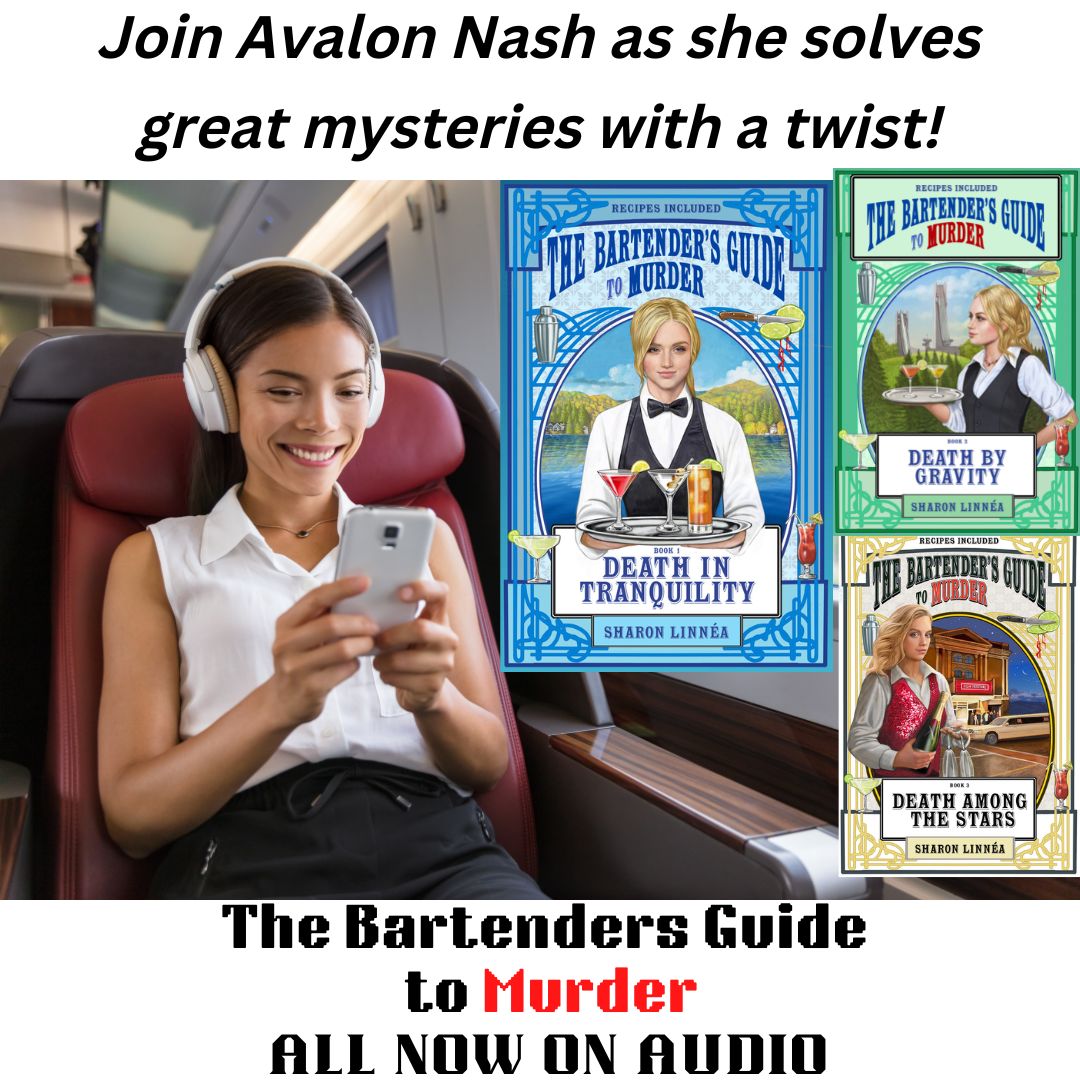
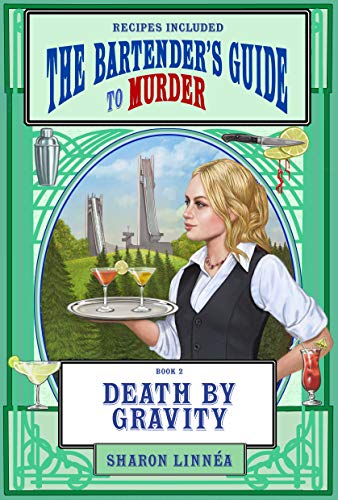
In any case, when I did briefly work as a bartender, the best part of the job, hands down, was hearing people’s stories. (Sound familiar?) From the beginning of time, we humans have loved hearing stories. Reading them is wonderful, and now watching them is a great pleasure. But hearing them can be a special treat. So I was thrilled when it was time to turn my latest books, The Bartender’s Guide to Murder, into audio books–and thrilled again when actor/director Abbie Pfaff was chosen to perform them. Listening to each of them, Death in Tranquility, Death By Gravity and Death Among the Stars, I am happy to report, they’re great!

Curious to find out what goes into recording an entire novel, I got Abbie to answer some pressing questions.

How did you decide to produce and narrate audio books?

A friend of mine in Chicago is a Talent Agent, she told me during the 2020 beginning of the pandemic that I would probably enjoy narrating since my background is in Directing and Film. She was absolutely spot-on. 

What parts of your theater education came in most handy?
Script analysis was crucial; piecing together every scrap you can find about a character and making them as round and squishy as possible. Directing instincts kick in when setting a scene, such as keeping track of the environment around the characters and how it affects them. And then, also bringing the scene that has just happened into the next by carrying the emotions or lack thereof. 

What goes into the process that normal listeners might not realize?
Staying up until 4 or 5am recording to avoid the neighbors’ lawnmowers being in the background [if you have your own home studio]. Or the amount of thought that goes into which characters will be afforded a lower resonance. I’m not a big masculine creature, but I sure try to sound like one every once in a while. 

What were the most enjoyable parts of the Bartender’s Guides to Murder to record?
The climactic scenes where Avalon is in the thick of it, practically stepping on the murderers. Those scenes carry themselves in Avalon’s emotional state and anxious thoughts.

What parts were most challenging?
Most challenging of all, would be the beautiful art of pronouncing words, specifically alcohol brands. I worked as a bartender in Chicago for multiple theater venues and even with that, I can say with certainty, I was not prepared. Challenging, yet very rewarding to learn. 

Which characters did you enjoy voicing?
The way Investigator Spaulding somehow both takes charge of a room and then also cares so deeply for what Avalon has gleaned, he was absolutely enjoyable to play opposite of Avalon’s curiosity and playful nature. Glenn MacTavish has my heart in the recording booth, he is a teddy bear of love. Sally, she was a blast, a firecracker personality I’ve met many times in the theatre world. Alma Eddings, for her terrible discomfort with visitors. Isobel Lester, the woman could side-eye. To name a few. 

Any that were harder?
Accents were a struggle at times. Glenn MacTavish’s thick Scottish accent, as well as Avantika’s soft Indian accent, were difficult to get right. Eventually, with enough takes, I was able to hear their personalities shine through. 

What is your usual process for working?
Read the book, script analysis, highlighting, and plan the voices. Record for a few days, edit files for a few days, repeat. Proofing multiple times for any mistakes. Communication with the author throughout. 

What is your prep work? What percentage of the process is the actual reading?

It is a huge chuck of the process, at least a week goes into reading/rereading and analysis/notes. I place time “beats” and emotion based “beats” in the script to make the recording smoother later. I highlight character dialogue and character thoughts, this creates a quick signal in the booth to prepare for vocal shifts so that I will not need to stop. I research accents, research specific people’s voices, and pronunciation research. Luckily, I find joy in paperwork and zen in small details, otherwise it might have not been such a great career switch. 

Is there a time of day you prefer to work? An amount of reading you can do at one time?
I am a night owl. My workday begins around 3pm when editing and ends before midnight. With breaks, of course. On recording days, I start at 11pm and end sometime before 2am, preferably. Though, sometimes it is necessary to record up to when the birds wake up. I’ll go as long as I can, depending on how rough my vocals sound. I take a 10 minute vocal break for every 50 minutes recording.

Any thoughts for someone who might be interested in audio book narration?
Tell the story. Whatever you can do to help the words come to life in a way that benefits the narrative, do it. Your author matters, they know the meaning of each sentence they have written. They are a valuable resource that you should respect and communicate with. 

If you are listening to a well performed and produced audio book, what do you know to appreciate?
Their silences and pauses. The way the spit sounds and click sounds are edited out. How they use their breathing as a tool. How they are able to not annoy people even after hours of hearing them speak. 

Since each of the Bartender’s Guides to Murder features the recipe for a cocktail or mocktail after each chapter, it seems we should ask, what’s your drink of choice? 

Amaretto Sour is my natural go-to. However, I made a deal with myself that once I finished narrating the Bartender’s Guide to Murder series I would make some of the drink recipes from the books. “Waffles and Sympathy,” from chapter 10 of the first book, is at the top of my list. 

Click here to start listening now!
https://www.amazon.com/Death-Tranquility-Bartenders-Guide-Murder/dp/B09QFQ6XQ4/ref=sr_1_1?crid=EJ0MCM2Z0I56&keywords=death+in+tranquility&qid=1664570054&qu=eyJxc2MiOiIxLjI4IiwicXNhIjoiMS41MyIsInFzcCI6IjEuNTAifQ%3D%3D&s=audible&sprefix=death+in+tranquility%2Caudible%2C65&sr=1-1

Welcome to North Carolina

Apparently, we aren’t the first or only New Yorkers who planned to move to North Carolina. In fact, every workman who came to fix up our house to put it on the market claimed to be heading south within the next couple of years. Or, short of going themselves, Marty from Retro Modern has a sister who’s moved down and “loves it but it drives her crazy that they ask you five questions before they pour your cup of coffee,” and John, our car mechanic, has an aunt and uncle who came down but he doesn’t like to visit because they “live on one of those chichi golf courses.” So many people were or had moved down that Bob and I thought maybe we’d go to our local NC farmers markets and call out, “New York!” and see how many people respond.* (*We never did this. In fact, we got NC plates for our cars ASAP.)

Meanwhile, we did move down. Of course, it was the middle of COVID so we couldn’t exactly go out line dancing every night. But we did discover the local grocery store (5 minutes to the close one, 10 minutes to the big one, 14 minutes to the fancy one). We started sampling takeout from various nearby restaurants.

In short, we are starting to get the lay of the land. Here are a few things we’ve discovered are delightfully specific to our new stomping grounds.

On a trip to the grocery, we discovered the shelves are stocked a bit differently.

There is an entire shelf of different kinds of grits, the same with cornbread mix. Local cornbread is often not sweet, so I was afraid when I couldn’t find Jiffy cornbread mix, which I need for my famous stuffing. Turns out I wasn’t looking hard enough. They come in 12-packs on the lower shelves.

Sadly for people watching their carbs, biscuits are a food group and come with nearly everything. Not rolls, mind you, biscuits. Can you even think about Bojangles or Cracker Barrel and not picture a plate of fall-apart, dip-in-honey pieces of heaven?

Bob and I have acquired new favorite tastes. His is pimento cheese dip. It’s a fresh made local delicacy around these parts, and you can get it any way you can imagine.

Our daughter Linnéa’s favorite is sweet tea. Somehow it’s not the same as plain old iced tea with sugar in it. It’s, well, sweet tea.

As far as drinks, I’ll go with Cheerwine. It’s a cherry flavored soda that is something of a precursor to Dr. Pepper. But it’s somehow just so southern.

As are Moon Pies. First, what size do you want, regular or mini? Chocolate, vanilla, mint chocolate…they’re serious about their Moon Pies.

Besides groceries, we have found some other happy differences.

It’s considered cold here at 46 degrees.

Happily, contractors work straight through the year. In Warwick, when I wanted to hire a deck contractor in December, he explained he’d start working again in April. The guys who poured our driveway would come in May. The gazebo people started up again in March but couldn’t get to us till July. Here, Hector asked to take off Christmas week and started work on our deck in early January. Sure, the team had to take a few days off here and there due to weather, but the project is was finished in February.

Speaking of inclement weather, of course our first winter included the “storm of the decade.” It really was. There hasn’t been a foot of snow in Asheville since 2011. Lucky us. The snowplow guys, who came up our driveway on ATVs, couldn’t get to us right away. Even though they cleared the snow, we were left with half an inch of ice on the driveway. The next day I tried to take the Subaru down. Nope. The car remained sideways at the top of the driveway for the next three days. Fortunately, we’d seen the storm coming and were well-provisioned.

No matter where we want to go, it’s 18 minutes from our house. Downtown Hendersonville, 18 minutes. Downtown Brevard, 18. The Asheville Airport, 18. You get the idea.

And there are hikes! So many hikes! When our daughter Linnéa visited we tried to find one and found 50. Pisgah Forest, DuPont Forest, Flat Rock, Carl Sandburg farm, the Biltmore Estate, Jump Off Rock, and Jump Off Rock (apparently, Cherokee princesses had no recourse when unlucky in love but to jump. I think this is likely the myth they told gullible white people whenever they didn’t want to divulge the real name of something.) But, seriously, you can spend your whole life hiking around these parts and never run out of waterfalls.

Our mail delivery person is Chris. She thinks the Fed Ex guys is rude for leaving packages at the bottom of our driveway and she’ll drive them up.

Before we moved into our house, when we came for the inspection, we briefly saw a pure white squirrel who looked like he was checking us out. We wondered if we’d ever see him again. Turns out, yes. And many of his aunts, uncles and cousins. We recently met Rita and John, the people who built the house, and asked if they fed the white squirrels. Rita claims one would sit in her lap and eat Hershey’s kisses. We’re a ways from that. A note: these are not albino squirrels, who have red eyes. They are a mutant variety, descended from the original two who were loosed in Brevard 50 years ago, and we love them. I’m wondering if I can import some pure black squirrels? They would look so good together.

Churches! There are churches every 6 feet. Well, maybe not quite every six feet, but there are a lot. Our favorite is up the road, just in the next county: Transylvania Baptist Church. There is Power in the Blood.

Lastly, we are half an hour from Asheville, a city bustling with arts, restaurants, breweries and entertainment, and bursting with history. We’ve already taken guests on the Comedy Tour and the Hop-On, Hop-Off Greyline Tour. We have annual passes to the Biltmore Estate and went with the kids and then with Barb at Christmas. We are regulars in the River Arts District.

The hard thing is, there’s so much to do right here near home, it’s not often we gear up to drive a whole half an hour to get to the city.

But when y’all come to visit, that will be a different story.

The Joy of Avalon

Has a novel ever helped you get through a hard time? They’ve helped me, so I was just wondering. Usually, when a book “takes me away,” it’s not the dense, classic type you study in school. Right now, when I need to get to sleep, I’m finding Fannie Flagg’s new novel THE WONDER BOY OF WHISTLE STOP is a great help. I love revisiting those folks from FRIED GREEN TOMATOES and finding out that some of them are doing just fine, thanks.

I’ve loved hearing and telling stories since I was a kid. I loved creating worlds and populating them. I had so many friends! Of course no one else knew them, or knew where the secret rock was, where we met. I also had breathtaking adventures as the youngest secret agent. Again, it’s nowhere on my resume (but would anything employing the word “secret” be on a resume?).

For me, now, writing is therapy. It’s where I channel my emotions and explore life’s questions. As you know from my last post, I started writing the Bartender’s Guide to Murder series after our catastrophic house fire. One thing you can be sure of: someone facing murder is worse off than me.

The mysteries I write tend to feature of cast of characters who are, for the most part, good folks. They’ve got issues–everybody’s got issues–but only one or two of them would actually kill anybody. The rest of them are dealing with life, in all it’s joy and sorrow and messiness and complexities, and with all it’s questions and quirks. That’s the part I love.

That’s why I’m so lucky to have Avalon Nash, my young bartender heroine. Avalon is smart, she’s intuitive, she’s got issues that go deeper than mine. But mostly, she asks questions. That’s what I love about writing these mysteries, is that I get to explore life’s questions–sometimes, the tough questions–alongside folks I like. Even if they’re fictional.

The second of Avalon’s adventures, Death by Gravity, is coming out on December 2. In it, she deals with some more difficult issues than she did in the first book. I’m grateful for the reviews the book has gotten, but I’m a little afraid when people call these books “cozies.” One person said the first book was “squeaky clean” except for some language in difficult scenes.

I never meant the books to be cozies or squeaky clean. I do believe difficult things are sensitively handled. Violence is referenced but happens offstage. They’re rated PG-13, at most.

I do hope the tone is one of hope. That’s what I need to work through all the craziness in this world to get to. That’s where I direct my stories.

If novels have helped get you through hard times, I’d love to hear which ones. I always feel those of us who have read the same books have friends in common.

Oh, here’s a special offer. If you’ve read a Bartender’s Guide mystery, or even if you haven’t, if you email me at Sharon@SharonLinnea.com with the subject line Drinks to Die For, I’ll send you a fun ebooklet with some yummy recipes from the books.

In the meantime, cheers!

Sharon

Image

Who I Met At the Station

Five years ago, we had a serious house fire. We had to live somewhere else for a year while our home was rebuilt. It was traumatic, to say the least (see previous post). My wise husband suggested, no matter how fraught life had become, I should be writing. Writing is my therapy, my way of processing. Harlan Coben says it this way, “If I don’t write, I hate myself. Simple as that. My life is out of balance.” Okay, I don’t hate myself. But my life is out of balance. Bob suggested I write something “fun” to counter the stresses in other parts of life.

But write what? Or, for a novelist, the question is, write who?

The summer between his junior and senior year of high school, my son Jonathan announced he’d like to train to be a bartender. I said, funny thing, so would I. So we did. We decided to take the course in 1 week. Hardest thing either of us had ever studied for. We studied together in the car for the hour and a half down to the school, we went to school all day, we studied the hour and a half back. There was a written test and a drink test–you had to make 6 cocktails randomly called out to you in four minutes. But! Once you are a bartender, a good deal of your job is talking to people. And for voyeurs like novelists, it’s hog heaven. Or vodka-heaven. Perhaps it would be for a sleuth. The irony is, I’m not much of a drinker. I’m in it for the mixing of flavors and the conversation. I sat down and started to write, wondering who would show up.

A young woman, at a train station. She was running away from her life in Los Angeles. Her mom is a successful, if controversial, comedian and her father is a well-known conservative pastor. Her name is Avalon, her best friend has just died. She is changing trains to head to her family home in Brooklyn.

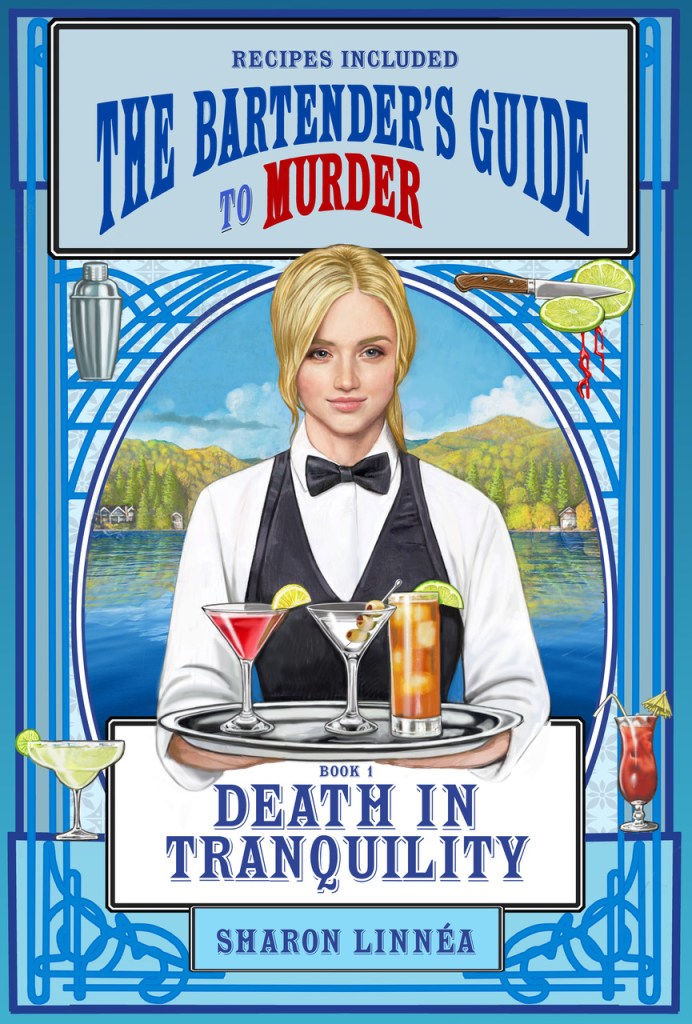
A young woman, unexpectedly at a crossroads, not knowing for sure where she’s going or what’s coming next. A young woman searching for a home who loves hearing people’s stories–and who knows how to bartend. Sound familiar? She turned out to be someone I might enjoy travelling with through the changes in this crazy world. Perhaps you would, too. If you’d like to meet her, keep reading. Here’s the first chapter of Death in Tranquility, Book 1 from The Bartender’s Guide to Murder.

Chapter 1 Death in the Afternoon

“Whenever you see the bartender, I’d like another drink,” I said, lifting my empty martini glass and tipping it to Marta, the waitress with teal hair.

“Everyone wants another drink,” she said, “but Joseph’s missing. I can’t find him. Anywhere.”

“How long has he been gone?” I asked.

“About ten minutes. It’s not like him. Joseph would never just go off without telling me.”

That’s when I should have done it. I should have put down forty bucks to cover my drink and my meal and left that magical, moody, dark-wood paneled Scottish bar and sauntered back across the street to the train station to continue on my way.

If I had, everything would be different.

Instead I nodded, grateful for a reason to stand up. A glance at my watch told me over half an hour remained until my connecting train chugged in across the street. I could do Marta a solid by finding the bartender and telling him drink orders were stacking up.

Travelling from Los Angeles to New York City by rail, I had taken the northern route, which required me to change trains in the storied village of Tranquility, New York. Once detrained, the posted schedule had informed me should I decide to bolt and head north for Montreal, I could leave within the hour. The train heading south for New York City, however, would not be along until 4 p.m.

Sometimes in life you think it’s about where you’re going, but it turns out to be about where you change trains.

It was an April afternoon; the colors on the trees and bushes were still painting from the watery palate of spring. Here and there, forsythia unfurled in insistent bursts of golden glory.

I needed a drink.

Tranquility has been famous for a long time. Best known for hosting the Winter Olympics back in 19-whatever, it was an eclectic blend of small village, arts community, ski mecca, gigantic hotels and Olympic facilities. Certainly there was somewhere a person could get lunch.

Perched on a hill across the street from the station sat a shiny, modern hotel of the upscale chain variety. Just down the road, father south, was a large, meandering, one-of-a-kind establishment called MacTavish’s Seaside Cottage. It looked nothing like a cottage, and, as we were inland, there were no seas. I doubted the existence of a MacTavish.

I headed over at once.

The place evoked a lost inn in Brigadoon. A square main building of a single story sent wings jutting off at various angles into the rolling hills beyond. Floor-to-ceiling windows made the lobby bright and airy. A full suit of armor stood guard over the check-in counter, while a sculpture of two downhill skiers whooshed under a skylight in the middle of the room.

Behind the statue was the Breezy, a sleek restaurant overlooking Lake Serenity (Lake Tranquility was in the next town over, go figure). The restaurant’s outdoor deck was packed with tourists on this balmy day, eating and holding tight to their napkins, lest they be lost to the murky depths.

Off to the right—huddled in the vast common area’s only dark corner—was a small door with a carved, hand-painted wooden sign which featured a large seagoing vessel plowing through tumultuous waves. That Ship Has Sailed, it read. A tavern name if I ever heard one.

Beyond the heavy door, down a short dark-wood hallway, in a tall room lined with chestnut paneling, I paused to let my eyes adjust to the change in light, atmosphere, and, possibly, century.

The bar was at a right angle as you entered, running the length of the wall. It was hand-carved and matched the back bar, which held 200 bottles, easily.

A bartender’s dream, or her undoing.

Two of the booths against the far wall were occupied, as were two of the center tables.

I sat at the bar.

Only one other person claimed a seat there during this low time between meal services. He was a tall gentleman with a square face, weathered skin, and dark hair pulled back into a ponytail. I felt his cold stare as I perused the menu trying to keep to myself. I finally gave up and stared back.

“Flying Crow,” he said. “Mohawk Clan.”

“Avalon,” I said. “Train changer.”

I went back to my menu, surprised to find oysters were a featured dish.

“Avalon?” he finally said. “That’s—”

“An odd name,” I answered. “I know. Flying Crow? You’re in a Scottish pub.”

“Ask him what Oswego means.”  This was from the bartender, a lanky man with salt-and-pepper hair. “Oh, but place your order first.”

“Are the oysters good?” I asked.

“Oddly, yes. One of the best things on the menu. Us being seaside, and all.”

“All right, then. Oysters it is. And a really dry vodka martini, olives.”

“Pimento, jalapeño, or bleu cheese?”

“Ooh, bleu cheese, please.” I turned to Flying Crow. “So what does Oswego mean?”

“It means, ‘Nothing Here, Give It to the Crazy White Folks.’ Owego, on the other hand means, ‘Nothing Here Either.’”

“How about Otego? And Otsego and Otisco?”

His eyebrow raised. He was impressed by my knowledge of obscure town names in New York State. “They all mean, ‘We’re Just Messing with You Now.’”

“Hey,” I said, raising my newly delivered martini. “Thanks for coming clean.”

He raised his own glass of firewater in return.

“Coming clean?” asked the bartender, and he chuckled, then dropped his voice. “If he’s coming clean, his name is Lesley.”

“And you are?” I asked. He wasn’t wearing a name tag.

“Joseph.”

“Skål,” I said, raising my glass. “Glad I found That Ship Has Sailed.”

“That’s too much of a mouthful,” he said, flipping over the menu. “Everyone calls it the Battened Hatch.”

“But the Battened Hatch isn’t shorter. Still four syllables.”

“Troublemaker,” muttered Lesley good-naturedly. “I warned you.”

“Fewer words,” said Joseph with a smile that included crinkles by his eyes. “Fewer capital letters over which to trip.”

As he spoke, the leaded door banged open and two men in chinos and shirtsleeves arrived, talking loudly to each other. The door swung again, just behind them, admitting a stream of ten more folks—both women and men, all clad in business casual. Some were more casual than others. One man with silvering hair actually wore a suit and tie; another, a white artist’s shirt, his blonde hair shoulder-length. The women’s garments, too, ran the gamut from tailored to flowing. One, of medium height, even wore a white blouse, navy blue skirt and jacket, finished with hose and pumps. And a priest’s collar.

“Conventioneers?” I asked Joseph. Even as I asked, I knew it didn’t make sense. No specific corporate culture was in evidence.

He laughed. “Nah. Conference people eat at the Blowy. Er, Breezy. Tranquility’s Chamber of Commerce meeting just let out.” His grey eyes danced. “They can never agree on anything, but their entertainment quotient is fairly high. And they drive each other to drink.”

Flying Crow Lesley shook his head.

Most of the new arrivals found tables in the center of the room. Seven of them scooted smaller tables together, others continued their conversations or arguments in pairs.

“Marta!” Joseph called, leaning through a door in the back wall beside the bar.

The curvy girl with the teal hair, nose and eyebrow rings and mega eye shadow clumped through. Her eyes widened when she saw the influx of patrons.

Joseph slid the grilled oysters with fennel butter in front of me. “Want anything else before the rush?” He indicated the well-stocked back bar.

“I’d better hold off. Just in case there’s a disaster and I end up having to drive the train.”

He nodded knowingly. “Good luck with that.”

I took out my phone, then re-pocketed it. I wanted a few more uncomplicated hours before re-entering the real world. Turning to my right, I found that Flying Crow had vanished. In his stead, several barstools down, sat a Scotsman in full regalia: kilt, Bonnie Prince Charlie jacket and a fly plaid. It was predominantly red with blue stripes.

Wow. Mohawk clan members, Scotsmen, and women priests in pantyhose. This was quite a town.

Joseph was looking at an order screen, and five drinks in different glasses were already lined up ready for Marta to deliver.

My phone buzzed. I checked caller i.d. Fought with myself. Answered.

Was grabbed by tentacles of the past.

When I looked up, filled with emotions I didn’t care to have, I decided I did need another drink; forget driving the train.

The line of waiting drink glasses was gone, as were Marta and Joseph.

I checked the time. I’d been in Underland for fifteen minutes, twenty at the most. It was just past three. I had maybe forty-five minutes before I should move on.

That was when Marta swung through the kitchen door, her head down to stave off the multiple calls from the center tables. She stood in front of me, punching information into the point of sale station, employing the NECTM—No Eye Contact Tactical Maneuver.

That’s when she told me Joseph was missing.

“Could he be in the restroom?”

“I asked Arthur when he came out, but he said there was nobody else.”

I nodded at Marta and started by going out through the front hall, to see if perhaps he’d met someone in the lobby. As I did a lap, I overheard a man at check-in ask, “Is it true the inn is haunted?”

“Do you want it to be?” asked the clerk, nonplussed.

But no sign of the bartender.

I swung back through into the woodsy-smelling darkness of the Battened Hatch, shook my head at the troubled waitress, then walked to the circular window in the door. The industrial kitchen was white and well-lit, and as large as it was, I could see straight through the shared kitchen to the Breezy. No sign of Joseph. I turned my attention back to the bar.

Beyond the bar, there was a hallway to the restrooms, and another wooden door that led outside. I looked back at Marta and nodded to the door.

“It doesn’t go anywhere,” she said. “It’s only a little smoker’s deck.”

I wondered if Joseph smoked, tobacco or otherwise. Certainly the arrival of most of a Chamber of Commerce would suggest it to me. I pushed on the wooden door. It seemed locked. I gave it one more try, and, though it didn’t open, it did budge a little bit.

This time I went at it with my full shoulder. There was a thud, and it wedged open enough that I could slip through.

It could hardly be called a deck. You couldn’t put a table—or even a lounge chair—out there.

Especially with the body taking up so much of the space.

It was Joseph. I knelt quickly and felt for a pulse at his neck, but it was clear he was inanimate. He was sitting up, although my pushing the door open had made him lean at an angle. I couldn’t tell if the look on his face was one of pain or surprise. There was some vomit beside him on the deck, and a rivulet down his chin. I felt embarrassed to be seeing him this way.

Crap. He was always nice to me. Well, during the half an hour I’d known him, he had been nice to me.

What was it with me discovering corpses? It was certainly a habit of which I had to break myself.

Meanwhile, what to do? Should I call in the priest? But she was within a group, and it would certainly start a panic. Call 911?

Yes, that would be good. That way they could decide to call the hospital or the police or both.

My phone was back in my purse.

And, you know what? I didn’t want the call to come from me. I was just passing through.

I pulled the door back open and walked to Marta behind the bar. “Call 911,” I said softly. “I found Joseph.”

It took the ambulance and the police five minutes to arrive. The paramedics went through first, then brought a gurney around outside so as to not freak out everyone in the hotel. They loaded Joseph on and sped off, in case there was anything to be done.

I knew there wasn’t.

The police, on the other hand, worked at securing the place which might become a crime scene. They blocked all the doorways and announced no one could leave.

I was still behind the bar with Marta. She was shaking.

“Give me another Scotch,” said the Scotsman seated there.

I looked at the bottles and was pleasantly surprised by the selection. “I think this calls for Black Maple Hill,” I said, only mildly surprised at my reflexive tendency to upsell. The Hill was a rich pour but not the absolute priciest.

He nodded. I poured.

I’m not sure if it was Marta’s tears, or the fact we weren’t allowed to leave, but local bigwigs had realized something was amiss.

“Excuse me,” the man in the suit came to the bar. “Someone said Joseph is dead.”

“Yes,” I said. “He does seem to be.”

Marta swung out of the kitchen, her eyeliner half down her face. “Art, these are your oysters,” she said to the man. He took them.

“So,” he continued, and I wondered what meaningful words he’d have to utter. “You’re pouring drinks?”

It took only a moment to realize that, were I the owner of this establishment, I’d find this a great opportunity.

“Seems so,” I said.

“What goes with oysters?” he asked.

That was a no-brainer. I’d spied the green bottle of absinthe while having my own meal. I poured about three tablespoons into the glass. I then opened a bottle of Prosecco, poured it, and waited for the milky cloud to form.

He took a sip, looked at me, and raised the glass. “If I want another of these, what do I ask for?”

As he asked, I realized I’d dispensed one of Ernest Hemingway’s favorite libations. “Death in the Afternoon,” I replied.

He nodded and went back to his table.

It was then I realized I wasn’t going to make my train.

* *

Ernest Hemingway’s Death in the Afternoon

Ingredients

3 tablespoons (1 1/2 ounces) absinthe

1/2 to 3/4 cup (4 to 6 ounces) cold Champagne or sparkling wine

Method

Hemmingway’s advice, circa 1935: “Pour one jigger absinthe into a Champagne glass. Add iced Champagne until it attains the proper opalescent milkiness. Drink three to five of these slowly.”

https://www.amazon.com/Death-Tranquility-Bartenders-Guide-Murder-ebook/dp/B08GL1YCSG/ref=sr_1_1?crid=3JUW12P3RYGLN&dchild=1&keywords=death+in+tranquility&qid=1600547234&s=digital-text&sprefix=death+in+tranquility%2Caps%2C475&sr=1-1

Or get a signed copy of the trade paperback from The Bookstore Plus in Lake Placid, NY https://www.thebookstoreplus.com/adirondack-fiction?fbclid=IwAR2U60K59eyDerpyz3SZnqRzTrc0pHv1Tx_XFXPxIbBTsSgD9t_z2XqDDEM

Sharon Linnea is the bestselling author of the Eden Thrillers (Chasing Eden, Beyond Eden, Treasure of Eden & Plagues of Eden) with co-author B.K. Sherer, following the adventures of Army chaplain Jaime Richards. She is also the author of the Movie Murder Mystery These Violent Delights, and the YA spy thriller Domino 29 (as Axel Avian). Sharon wrote the Carter Woodson Award-winning biography, Princess Ka’iulani: Hope of a Nation, Heart of a People, and Raoul Wallenberg: The Man Who Stopped Death.  She enjoys visiting book clubs virtually and in person. Sharon@SharonLinnea.com

Visit Her Author Website  SharonLinnea.com

Things We Gained in the Fire: 6 Gifts of Adversity

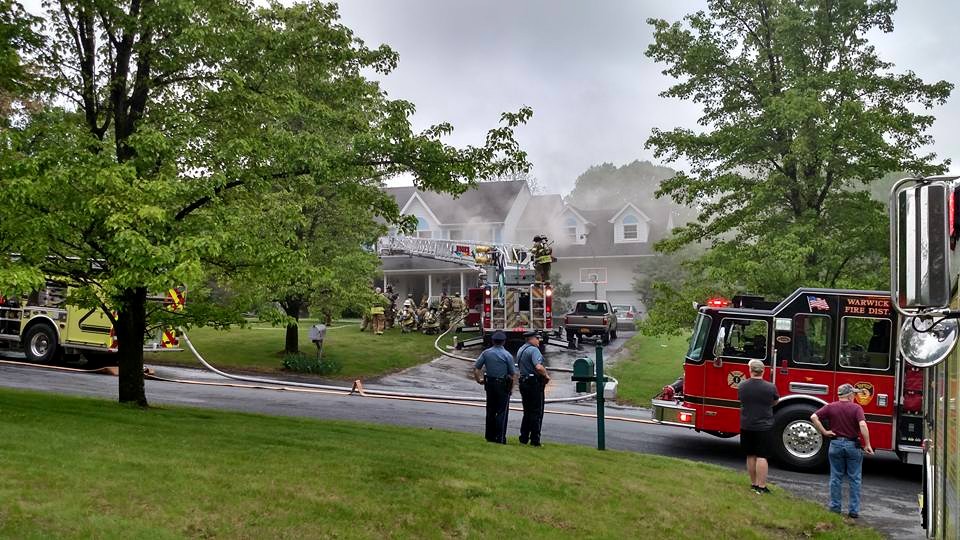
Two years ago, on May 17, our lives changed abruptly. It was 8 a.m. on a pastel Spring Sunday morning; my husband was on his way to work in New York City; our daughter, a high school senior, and son, a college sophomore recently returned home, were zonked out in their rooms. I’d fed the dogs and cats, and settled comfortably into the chair at my desk in my upstairs office with a bowl of oatmeal and a cup of joe to catch up on a few things before church.

Something smelled strange. Did the neighbors have a fire in their fireplace? It seemed early in the morning and late in the season. I opened the window, then walked the hall; nothing suspicious.

Three minutes later, the smell of burning. I walked the hall again. This time, there was thick black smoke pouring out of a vent by the stairs. The fire alarms went off.
“Fire!” I said, pounding on each of the kids’ bedroom doors. “Fire! Get up, get out!”

That’s when I discovered you actually can get teenagers out of bed immediately at 8 a.m. on a Sunday.

We leashed the dogs and shooed the cats out and my daughter grabbed her hamster. I scanned the house for any other living beings; within three minutes, smoke had become so intense you could barely see your hand in front of your face.

Rhetorical Question: What would you save in the event of a fire?

Actual Answer: Your family. The rest is commentary.

The volunteer fire department arrived quickly. We live in a large town but a small community; as the address went out over the emergency band, the kids’ phones lit up. Our street threw an impromptu “come as you are” early Sunday block party.

house on fire

Those first hours are a blur. Eventually,the neighbors went home, the firefighters and police packed up and the ambulance was dismissed. Newly homeless, I called the 800 number of our insurance company. They couldn’t find us without the policy number, which was…in the house. I hung up and called back. This time the agent found the policy, took my name and phone number and said someone would get back to me by Tuesday. Seriously? What did we do until Tuesday? How did I even begin?

Then our neighbor Trish called our local agent, and, like a good neighbor, within the hour, Bonni Oswald, was there. It was clear a) she was a truly caring person, and b) this wasn’t her first fire-demolished rodeo. She contacted the company for us, and the necessary folks started rolling in. The Loss Unit turned us over to the Large Loss Unit. Bonni gave us cash for immediate needs and instructions for us to rent somewhere to stay and charge it to State Farm.

All of this happened when I was in Adrenaline Mode. I couldn’t process the fact that many of my Earthly possessions had gone to heaven before me or that our cats were out in the coyote-infested wild or that I didn’t live on my street any more. I was focused on the knowledge that, as a parent, it was my duty to keep my family and other dependents housed, fed and safe. Those first days, nothing else really mattered.

Even while charting the map through New Normal, as the size of the loss and complexity of rebuilding our lives became clearer, there began to be glimpses of gold nuggets amongst the ore. I decided the only way through would be to grab onto the positive, to keep watch for things we’d eventually gain in the fire. Here are six long-term positives that came out of one massive negative–and I suspect they’re the same for many types of adversity.

Resilience. The week after the fire, a national magazine had a cover piece on the psychology of resilience. Dr. Philip Keller, one of the field’s leading researchers, explained that a key elements of a psyche that can bounce back is a history of hard times. Facing challenges and difficulties is the only way to learn to flex and strengthen the “meeting challenges” muscle. People who have an easy life are those who sink when faced with catastrophe. Dr. Keller believes this to the extent that he felt, as a father, it was his duty to teach his offspring to face life-threatening challenges. As a result, when each child turned 18, he took them on a life-threatening adventure, to fight their way out of the Amazon jungle or up and down an oxygen-deprived mountain peak. What his children had in common, upon returning home alive, was two-fold. The progeny now knew they could survive almost anything—losing that job interview wasn’t that big a deal—and, each told their father they never wanted to speak to him again. Lucky me! Our family was facing a true life challenge and it wasn’t my fault! We could face this ultimate challenge together, and the kids didn’t have to hate me for putting them through it.

Identity. It’s funny, how much of our identity has to do with this is where I live, this is my stuff; my grandmother’s rock collection, my mother’s beloved Lladro angels, the ribbon I won at the 3rd grade science fair. Each reflects a time and place, a series of choices and experiences. When they’re gone, who are you? With the exception of my children’s first two years, we had always lived in this house. Now, when the kids came home, we lived somewhere temporary. And it was okay—good, even. It proved that we were a family no matter where we were. I was a writer even without my office or my books or papers. I found I had to write, to remain sane. In fact, the things that were authentic held fast and proved to be strong and deep. And we put up a sign in the foyer: Life takes you to unexpected places. Love always brings you home.

Endurance. Anyone who faces a disaster quickly discovers that there is a community of people who dwell daily in the detritus of your particular catastrophe. While it is new and abrupt for you, it is their same-old-same-old. We were fortunate to have good insurance. It didn’t bring anything back, but the house was immediately taken over by people who knew what they were doing. One thing they were doing was making an inventory and packing up every.single.thing.in.the.house, at which point our lives became a two-year journey along the Drowning in Paper Trail..

When you move on purpose, you have a chance to choose what to take and what to get rid of. We had no such opportunity. They cataloged everything. And, once this was done, things that had survived the fire—non-working light bulbs, VHS tapes, junk in the junk drawer—were packed into hundreds of the nearest boxes and put into storage. (A month after we moved back, I unpacked a box containing my half-eaten bowl of oatmeal, spoon cemented to its contents for eternity.)

Then a list of things that did not survive the fire, 3,000 of them, from Mario Kart game cartridge to living room sofa—were presented to us in a grid. I was to go through these items and give the insurance company the price for which they were purchased, at any time during the last 30 years.

It became a year of slogging. Not only through unending paper work, but of phone calls and meetings and signing off on a million things. Usually, when you redo a room, say, your kitchen, you have happy months of planning and choosing. When you have to do every room at once, and instantly, it’s not the same joie de vivre. Also, the house had to be brought up to current code—no grandfathering in! That meant, among other things, a brand new $10,000 egress from the basement.

Even with a contractor we trusted and insurance adjusters who were on our side, It was never-ending. (And TiVo, stop charging us for service to an empty house and melted machines. This is my fifth call! Stop it!) Meanwhile, none of my other obligations had gone away. Prioritizing was key, and keeping on keeping on, even when it felt like another day of chewing Kleenex, was absolutely necessary. When life becomes a marathon and you have no choice but to run it, you find an endurance you never knew you had.

Letting go. My hardest day of clean-up at the house was when we found a boxed wedding gown in the basement, and it was so badly burned that I couldn’t tell if it was mine or my mother’s. It was tangible proof that the past had been taken, forcibly, and the physical proof of it was gone. Somehow, the fact that we lost so many things, that their discovery was unrelenting, on a daily basis, made it a dwelling place with which I was familiar, and eventually, comfortable. I recognized a stark demarcation between people and things.

There also became an obvious choice between holding on and mourning each thing, making life a continual pit of quicksand, or, (as was popular at the time), thanking each thing for its service and continuing on. Until I was shopping on Thanksgiving weekend with my then-college freshman daughter, and she said, “So we’ve lost all our Christmas ornaments—even the ones Jonathan and I made when we were little?” Somehow, that did it. I became the unhinged woman sobbing in the lighting aisle of Lowe’s.

But there was also a different, deeper, process of letting go that was triggered by the fire. I was doing fine, hitting my marks, doing what needed to be done, keeping it together—and suddenly, driving alone in the middle of a Tuesday, I couldn’t breathe. Could pull no oxygen into my system. I had to steer onto the shoulder and turn off the engine. The second time this happened, I realized what was going on. My subconscious was coming to grips with the fact that any control I thought I had over my life was an illusion. We are all going to die, it could be in 50 years, it could be in thirty seconds. Worse, our loved ones will die. We’re all one phone call away from disaster, one bowl of oatmeal and smell of smoke from our lives becoming something completely else. And there’s not a damn thing to do about it, except acknowledge it and come to terms. The funny thing is, once I was freed from trying to control my life, I was able to dwell much more spontaneously in, and be more appreciative of, the moment at hand.

Gratitude. Once you’ve had a catastrophe, it becomes open season for everyone else’s horror stories. You hear of people who lost loved ones or pets in their fire, of people who had no insurance and lost everything, of people who had insurance that would only repaint the puce wall puce and replace a 23-year-old red fringe chair with an identical 23-year-old red fringe chair. We’re grateful that State Farm (who has now dropped us, by the way) wanted what our mortgage holder wanted: the dwelling to be worth as much or more than it had been, pre-fire. It could have been so much worse. Even our cat Crystal, who was so freaked out by the fire and all the subsequent strangers that she ran away,  was eventually caught in a Have-A-Heart trap and is now back, calm and happy, in the bosom of the family.

Shortly after my Great Lowe’s Meltdown, I went onto Facebook and asked any family and friends who might be inclined to send us a Christmas tree ornament that would, in some way, remind us of them. The response was overwhelming. We got ornaments from all over the U.S., as well as overseas. The ornaments came from people who celebrated Christmas, and those who did not. Our children’s first nanny sent ornaments made from photos of the children in their first years. One friend of my daughter’s, only home from college and in town for an hour, spent much of that time running into our house, hanging an ornament on the tree, and running back out.

Now our tree has come to have a wonderful, happy new meaning for us each December, as it is a virtual hug from friends and loved ones, far and near. We are grateful for each and every one. The ornaments stand for everyone who helped us through the hard time, from the fire fighters, to the insurance adjusters, to the neighbors, to the people who worked at the utilities, plumbers, painters, drywallers. There are many good people in this world.

Fresh start. Now, two years beyond the fire, we can be profoundly grateful for the fresh start the fire gave us. Neighbors whose kids have grown are having to update their homes for sale. Ours is completely updated! Kitchens, bathrooms, bedrooms, wiring, plumbing, you name it! We have that double oven I always wanted and the gourmet cooktop my husband lusted after. The basement is large and light and legal. The paint is not puce. All the stuff we’d saved for decades, and would have to go through someday? Gone. (Well, except for one garage bay. And if you’re interested in half price Lladros or Hummels, let me know.)

Mostly, oddly, I have let go of even the things we still have. I know I could walk out the front door of our beloved house, leaving everything but living beings behind, and be okay. It’s nice to use this stuff, but it no longer defines who I am. That kind of makes every day a fresh start. And I am grateful.
christmas tree

Celebrating Books Every Day

World Book Day is celebrated this month in the United Kingdom (here it is World Book Night in April). School children are urged to dress up as a fictional character. Apparently one little boy has already been sent home for coming in a “Christian Grey” suit. (If he was in my class, I’d have him go back to the hall and re-enter as Willy Loman. Problem solved.)

So, while it’s not OFFICIALLY World Book Day here, it did get me thinking that ANY day is the perfect time to celebrate books.

In that spirit, let me celebrate the books I am reading right now, or have recently finished. I don’t usually read 5 books at a time, but I am just now, all very different, and for different reasons.

station 11STATION ELEVEN by Emily St. John Mandel 

You might have heard that I’m not a big fan of end-of-civilization novels (scroll down to the post, “Hi-tailing It Out of Distopia” for an explanation). But my husband went out of town and left me this book with a note saying, “I think you’ll love it! Enjoy.” Now, my husband is sparing with his exclamation points, so I took the note seriously. The book is about a time in the not-too-distant future after a pandemic thinned the population by, well, almost everyone.

The story follows a small travelling company of actors and musicians who perform classical music and Shakespeare in the small settlements that remain. Granted, I haven’t finished the book, but the characters are interesting and real, and the book does seem to celebrate the good in humanity and even the “magical” everyday things we current readers take for granted.

DEAD UNTIL DAWN by Charlaine Harris

Yes, I realize I’m about 10 years behind everyone else, but there was a copy left by the bathtub and dead until Darkwhat is a girl to do? Isn’t it great that once books are written, they continue to exist and be unique? I’ve met Ms. Harris, she is a down-to-earth person who is nice to other writers and willing to dish about Alexander Skarsgard. I’d heard the Sookie novels were “episodic,” and the series was a little much for me. But what the heck?

Here’s the what: Sookie jumps in on the first page, a fully-realized character with a clear eye, a sense of humor and a big chain. There isn’t much she isn’t afraid of, and her crazy Southern world is introduced as normal-wacky. Vampires? Shape-shifters? Southerners you recognize and a town that feels like a real place? Obviously, a kajillion people read these books because they’re just plain fun. So what if the plots aren’t exactly tightly woven? And my best guess about the series is that somehow the men–the showrunners, the producers, writers, directors–co-opted Sookie and struck out on their own. Obviously they were successful, but it’s not the same thing.

Kaiulani Crown Princess WebbKAIULANI: CROWN PRINCESS OF HAWAII by Nancy and Jean Francis Webb

This one might strike you as kind of odd, after all, I did write a biography of Princess Kaiulani myself (that won the Carter Woodson Award, yay), and this biography was written back in 1962.  But here’s the deal. During the time my husband and I honeymooned in Hawaii, we saw a small newspaper article about Princess Kaiulani, and I fell in love with her.

I found the Webb’s book (and every other book on Hawaiian history in print) and then, we found the Webbs. They lived in Manhattan, as we did. By then, Nancy was battling Parkinson’s, but they welcomed us, time and time again, into their apartment. We would sit and talk for hours. A lot about Kaiulani and their journey to write the book, but also about their journey(s), period. They wrote radio dramas in the Good Old Days and had wonderful stories of a New York and a writing life not long gone. There is a new edition of their book out now, in paperback. My copy of their book is the hardcover, and it is signed. It is also falling apart. It is a prized possession.

Why did I pick this book up to start reading it? It was the beginning of a long journey, and I hadn’t read it in a long time. Some of the language used in 1962 sounds outdated now, even a bit insulting, but back then it was the politically correct speech of the day. But, they were a step closer to 1899, when “our princess” died. When they wrote, people who remembered Kaiulani were still alive. Honolulu was different 50 years ago, as it had been 50 years before the Webbs. But I’m loving it. Like a visit with old, beloved friends–and I mean both the Webbs and the Kalakauas.

LISTENING FOR THE HEARTBEAT OF GOD by J. Philip Newell

Every year, our church reads a book collectively during Lent. We are a church of people who love to learnListening for the Heartbeat and to discuss ideas. This is a book about Celtic Spirituality, and it is fascinating. Oftentimes we Christians don’t realize how much of what we find in the Scriptures has to do with the lens through which we read the text. For example, the idea of Original Sin was pretty much plunked whole into Church theology by Augustine, who did us some mighty favors and some mighty disservices.

It’s interesting to hear the argument for the theologians who lost the argument at that one specific time in history. “God saw all that he had made, and it was very good.” Suppose that theological statement is actually fact?  Wonderful, necessary discussions. I LOVE ideas. I LOVE discussions. I LOVE books.

Here are two books I just finished, and I found them interesting counterpoints to each other.

Boston GirlTHE BOSTON GIRL by Anita Diamant

The Boston girl is a grandmother who is telling the story of when she became herself to her granddaughter. It’s a very workable conceit. The main character came from a family of Jewish immigrants who arrived stone poor to live in the tenements of New York’s Lower East Side. Times were tough. Money was tight. Loved ones were lost. Marriage prospects were not happy ones. The possibility of education for girls was a far-away thought. And yet.

YET. Our heroine has pluck, she has hope–but mostly, she has friends. Her world broadens. Her thinking broadens. Her prospects,–finally–broaden. It is a specific person’s story, but in many ways, it is every immigrant’s story. It is a fast read, and it is wonderful.

WE ARE NOT OURSELVES by Matthew Thomas

Another immigrant saga, this one of poor Irish in the mid-to-late 20th century, it takes place in the Wwe are not ourselvesOuter Boroughs of New York City. Our heroine is also from a family who arrived stone poor (actually, drunk poor). Times were tough. Money was tight. Loved ones were lost. Marriage prospects were not happy ones. She managed an education. And yet.

YET. Our heroine is stoic, not plucky; without hope that things will get better (not because they couldn’t, but because, well, wherever you go, there you are), and most trenchantly, she has no friends. She is completely self-contained and self-absorbed. Friendship is dealt, like cards, not fallen into. It was the kind of book you admire greatly and don’t enjoy for a minute.

At least, that’s me. But the great thing is, there are books out there for everyone! There are new worlds and new ideas and new ways to think and to view the world and make us appreciate what we have, and then, on to the next. It’s quite the most marvelous thing.

julia-child-my-life-in-franceOkay, last one up: My Life in France by Julia Child

Very possibly, one of the most wonderful books, ever. And not because it’s Dostoevsky or even Mary Stewart. Simply because Julia Child is an  indomitable woman, who can find delight in any situation. If you have trouble sleeping at night, keep this book by your bed. When you wake up, start reading. The phantoms of the night will fade into the France of the 1950s, your worries will fade into butter (it is Julia), and you will soon drift off, with a smile on your face.


Tag Cloud