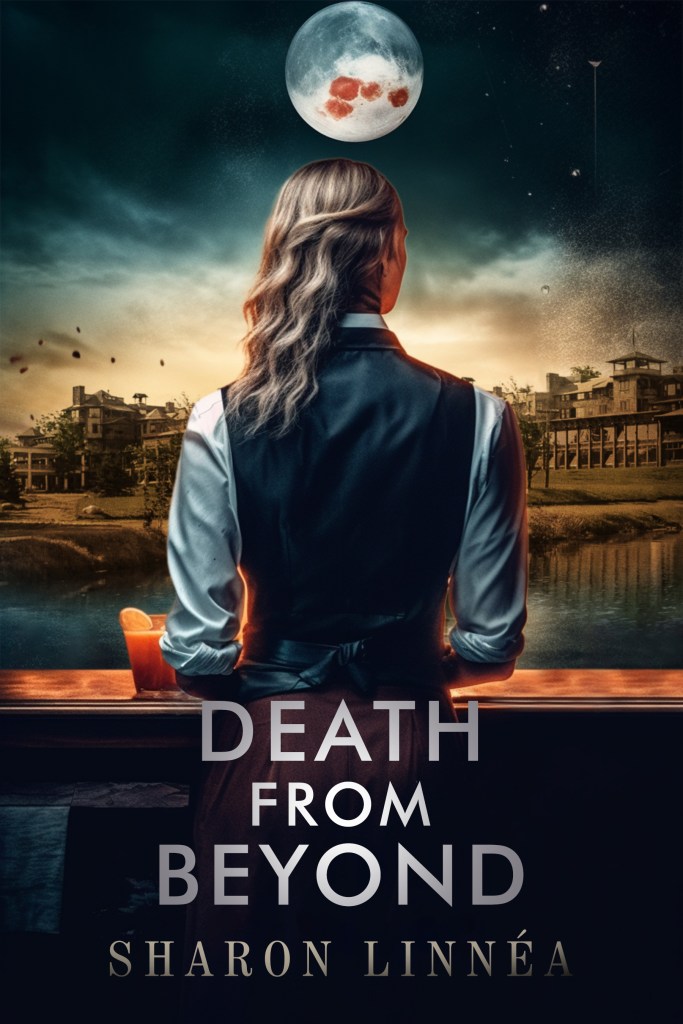
Death from Beyond
start reading chapter one
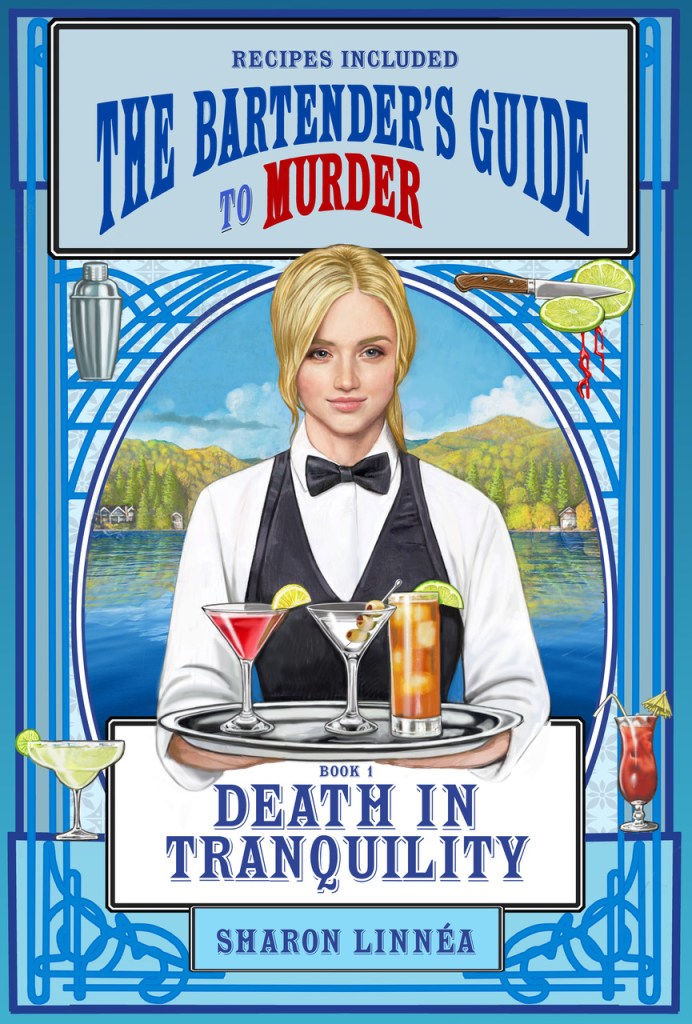
Bartender’s Guide to Murder book 4
Chapter 1
All Hallows’ Eve Eve
She sat down at the bar at 9:14 PM on the last Friday in October, a tall woman, with large hazel eyes, long nose, chiseled chin, paperwhite skin, and thick black hair. She wore an ecru shirt topped by an olive green jacket.
“I need some liquid courage,” she said.
“You’ve come to the right place.” I plunked down our Scary October Cocktail menu.
“The problem is, I can’t drink alcohol. Doesn’t mix with my meds.”
“Got you covered.” I turned over the cocktail menu to the mocktail side. The list was equally as long. “I’m afraid you’ll have to provide the courage yourself.”
“I’ll try the Fall Fiesta,” she said, choosing a cider-based libation.
“Coming up.”
It was Halloween weekend and the Battened Hatch was crazy busy. The Adirondack town of Tranquility went all-out for the holiday; in fact, it had been named Best Halloween Town by an upscale travel magazine. Folks flooded in. The Visitors Bureau concentrated on events for kids—parades, daytime trick or treating on Main Street, scavenger hunts. If you wanted witchy doings, you still had to head for Salem, Massachusetts. Or parties here to which I was not invited.
“Visiting for the holiday?” I asked, setting down the drink. “Would you like to see a food menu?”
“No, thanks. And I’m only kind of visiting. I grew up here. There’s a mini high school reunion tomorrow. My class was always weird. Instead of meeting up on Labor Day or some other three-day weekend, we did stuff on Halloween.”
“Oh, wow. I’m always of two minds about reunions. Is your family still in town?”
“Yes. Hence my need for alcohol.”
“Which you were smart enough not to drink.” I smiled and offered my hand, which was engulfed in her own. “Avalon.”
“Sandy.”
As we shook, I recognized the scent she wore: lily of the valley. It was one of my two signature scents. “Diorissimo?” I asked.
She stared at me, then a small smile crept onto her face. “How did you know?”
Certainly no one would accuse me of knowing my designer perfumes. But I did recognize this one. “Lily of the valley. Hardly anyone uses the fragrance in perfume anymore.”
“It was in our backyard, growing up. In the spring we had a volleyball net up. My friends and I spent many happy hours there.”
“It was in the garden behind my mormor’s brownstone in Brooklyn. They were planted closest to the house, in the shade. Every year, my grandmother spoke of how it grew outside the family homesteads in Tennessee and Småland, Sweden. She’s gone now—that whole generation is—but it makes me feel close to her, even for a while.”
“It reminds me of the happy parts of growing up,” Sandy said.
We took a second to smile.
It was then I noticed a pin she was wearing, a small pink flower with a scroll that said Sensitive Badass.
“Doubleclicks,” I said, nodding at it.
“You know the band?”
“Yeah. That’s a good song. Who these days doesn’t feel like a badass—albeit a sensitive one?”
“You got that right.”
“Let me know if you need anything else,” I said, pulling myself back to work.
Drink orders were stacking up. Halloween is a big creative cocktail holiday, unlike, say, Easter, when mimosas are your best bet. Tonight, the large carved bar behind me was glowing with an array of two hundred bottles; those in the center were being used almost as frequently as those in the well. I remembered the first time I saw it. While the rest of the Scottish pub is paneled with cherry wood, the bar itself is mahogany. It must have cost a fortune. Mahogany darkens over time. The carved wood wore its age and care impressively.
Marta, my assistant manager and co-bartender, swung back through the kitchen with a green plastic rack filled with glasses from the dishwasher. Marta used to think of herself as Goth. Now she wore the same clothing, which had miraculously morphed into bartender black. She’s eighteen, just graduated from high school, and taking a gap year to save money before going to art school. I honestly didn’t know what the Battened Hatch would do without her next year.
She stowed the glasses and we both got to work.
“Hey, Marta,” said Sandy.
“Hey…”
“Sandy.”
“Sandy,” said Marta.
“You work here?”
“Yes,” Marta smiled, holding up a Marvini glass.
“Cool,” said Sandy.
As the evening wore on, I watched Sandy out of the corner of my eye. Like virtually everyone who sat alone at the bar, she was checking her phone. She was naturally charismatic, with a twinkle in her eye, but there was something on her mind. She exuded an odd mixture of confidence and hesitation. She’d be perfectly cast in a Neil Gaiman series: ruler of some fascinating realm, who could tell plenty of interesting stories to a therapist. Or to a bartender. Maybe, if she was from here, she’d return when I had time to chat.
It’s funny how when you meet someone who will impact your life, you seldom know it. But sometimes, as happened that night, there is a connection, a silent buzzer that goes off, and you aren’t surprised when your lives become somehow intertwined.
Meanwhile, three ghosts and a woman dressed like Princess Leia in the Jabba the Hutt scene pressed in towards the bar for orders. This far north in New York State, nights were already dipping down into the thirties. Even inside, Princess Leia had to be freezing. She tossed her head haughtily towards any male person who smiled her way.
Around 9:45, a young man, maybe five-eight with a long-sleeved pullover and short hair, sidled up to the end of the bar. He held the hand of a wafer-thin woman of the same age, who followed behind. They both looked too young to drink.
“Hey. Marta,” he beckoned. She looked up, finished the potion she was mixing, and went over.
“Hey, Toby.”
“You’re coming Sunday, right?”
“I don’t know.”
“Come on. This is the last year we’re all going to be around, probably.”
“I’m still thinking. But maybe.”
“Get Colin to come. He’s always the best.”
“I’ll see.”
Toby did a two-fingered salute and headed back out of the Hatch. Which is what we call the Battened Hatch when we’re busy. The actual name, still on the pub sign outside, is That Ship Has Sailed. It’s inside MacTavish’s Seaside Cottage, a Scottish hotel that has never had cottages or been seaside. Whoever named the inn, I’ve long been a fan. I’ve managed the bar since I arrived in town in May and found the last bartender murdered, then stayed to find out why.
“Who was that?” I murmured to Marta.
“That was Toby and his girlfriend. He wants me and my friend Colin to go with them to investigate Appleton Lodge on Monday.” She used the soda gun to finish a Collins. She looked straight ahead as she said, “It’s supposed to be haunted.”
“Okay,” I said.
“They go every year.”
“And you don’t?”
“Why would I go looking for ghosts?”
I chuckled. Marta was a sensitive, meaning dead people found her. She was learning to control her gift, but I could see why she didn’t want to go into overload.
“Why don’t they go on Halloween?” It seemed like a natural time for exploring haunted venues.
“The other two lodges attached to Appleton burned down mysteriously, so the cops always watch it super carefully on times like Halloween. Then, the day after, they don’t.”
“Got it.” I could see how Marta would be hesitant to go. The large, rambling Adirondack-style inn had been empty for years. Probably everyone in town wondered if it was haunted. I could see how visiting it could entice local explorers.
Halloween was on a Saturday this year tomorrow. Tonight was crazy enough that Marta and I fell into a time warp. The only time I looked up was when Sandy paid with cash and I had to make change. “Hey, listen,” she said, seeming nervous. “Is there a chance…I could leave my suitcase here…and pick it up in an hour?”
“In an hour?”
“My folks live on Ivy Circle, just off Maple. It’s close enough I can walk, but I don’t think I can drag a suitcase all the way up. I’ll get my dad to drive down and pick it up.” When I paused, she said, “I asked the lobby bellman. He said the hotel is so full, if I’m not a guest, no can do.”
“Sure. Stick it in the back hall there, past the bathrooms. It should be safe enough.”
“Thank you very much,” said Sandy. She got up and dragged the brown suitcase I hadn’t realized was at her feet towards the bathrooms.
I turned back to work.
Oddly, our clients didn’t voice objection to us closing at eleven, our regular time. Maybe they had other places to go, or perhaps they were saving their Halloween energy for the next day. They all paid up, we closed out quickly, and my crew headed out happily enough that I knew they were going to continue celebrating. I never cared how they celebrated—as long as they were back in working form the next day.
I stood alone looking at the streamers of black and orange along the walls, mentally counting the hours until I could rip them down. Not a fan of streamers, crepe, or orange and black.
As I turned out the lights in the back hall, I saw that the brown suitcase was still there. It was well past an hour since Sandy left. Likely she and her family had been distracted and she’d come back for it tomorrow.
I put on my coat, hat, and gloves and locked the inside door—although Hugo, the night janitor, was heading over to start cleaning.
An expectant buzz tinged the frigid air even though the streets were emptying. I walked down Tranquility’s homey Main Street and turned up Maple, the same street Sandy would have turned up earlier. It climbed at a steep angle. Three cul-de-sacs branched off to the right. The first was Forest, the second, Orchard, the last, Ivy Circle. As I climbed that hill, north winds picked up, warning empty tree boughs of a hard night to come. I was glad to turn right onto Forest. It sat quiet and dark, interior lights glowing discreetly behind windows of well-built older homes, each surrounded by an acre or more of woodland. I walked the road to one especially solid residence at the end of the dead-end street. It was one story, Craftsman-style, its painted wooden porch empty. Dark windows on either side of the front door seemed to signal no one was home.
I knew someone was.
I didn’t go up the driveway but walked past it and started through the dead leaves on the left side of the house. It was the more level side of the property. Still, I knew enough to step carefully and go from tree to tree, steadying myself by holding onto trunks in the murky darkness, swirling leaves crackling like cellophane beneath my feet.
Finally rounding the back of the house, I came upon a profusion of illumination spilling from tall windows. Escaping strains of Rachmaninoff’s “Symphonic Dances” filtered, nearly muted, into the woods from inside the panes.
Before me sat an artist’s studio, attached to a back hallway of the dwelling. It was like another country. Intensive warm light, huge canvases with dancing colors, careful strokes, slashes, blues, green, browns, yellows, in shades of colors only artists know: cadmium chartreuse, India yellow, alizarin crimson, cerulean, phthalo emerald.
And a tall young man, wearing thick painter’s pants and no shirt, focused like a laser, like a train through Siberia, or Smaug guarding treasure. The strokes of his brush were purposeful, masterful, almost violent. The muscles of his back and his arms were firm and tensed in service to the work, gingerbread skin glistening with perspiration. His thick black hair was a tousled mess.
I stood and watched Philip work until the wind’s constant assault shook me. I realized how irritated he’d be if I froze to death and my body was found in his yard and he had to stop work to deal with it.
I made my way back, again from tree to tree. Gray flakes of early snow zipped past but nothing stuck. Thankful to be back on the road, I walk-jogged down to Main Street, then up to the employee parking lot, where I turned on my Subaru and cleared the frosted windows while waiting for the heater and my seat to warm up. I drove back down Main Street, now devoid of traffic but bursting with toy witches and cauldrons and promises of the next day’s treats.
The dirt lane from the main road up into my little glade was frozen firm. I parked in a makeshift spot down below just in case it got slick overnight.
The living room lamp I’d left on in my cottage served as a beacon. I walked up the path easily, past my landlady’s lodge, then grasped the railing tightly as I crossed the footbridge. The back patio was somewhat sheltered. My arrival cued the motion-activated light, which helped as I punched in the code to unlock the back door.
“Hi, Whistle,” I said to the little Pomeranian at my feet. I let her out to relieve herself, and we both happily returned to the warmth of the house.
“Yeah, I saw him,” I said. I made a cup of tea, and the small dog and I went into the living room, where I turned on the gas logs in the fireplace and pulled a soft white throw over my lap. My watch declared midnight. “Happy Halloween,” I said, as the little dog settled in. I knew it was going to be another lonely night.
* * * *
That is what I knew. Here is what I did not know until much later:
That Sandy shivered the half block down Main Street, then turned to trudge up the hill through the biting wind, until she came to the top, to Ivy Circle. That her parents were having a party and though it was late, the street was lined with cars. That the house in which she grew up, a lovely three-story dwelling, had light pouring from each window, golden light, like in the fairy tales. The pine tree in the front yard had a string of golden twinkle lights and the outline of a horn of plenty sat at each window. Her parents did not celebrate Halloween. There were no witches or ghosts. It was a harvest gathering.
As she climbed the front steps, the door opened and a middle-aged couple in heavy coats and carrying a tin of cookies took their leave. “Goodbye! Goodbye! Thanks for the lovely time!”
Sandy waited until they’d departed before she started up the steps.
I did not know that her father saw her first and started to ask, “What are you doing here?” when her mother saw clearly who it was, then said, “I need you GONE,” and slammed the door.
I didn’t know Sandy stood behind the garage, shivering, watching old family friends depart the house, get into their cars, and leave.
When her fingers stabbed with cold even through her gloves, she wandered back to the main road, walked down to Main Street, and retraced her steps to MacTavish’s Seaside Cottage. The bar was locked, but the lights were on. She sat unobtrusively in the lobby and watched a couple, late arrivals, check in at reception, others stopping to ask what around this town was still open—didn’t they know this was Friday night?
When Hugo, a sturdy, balding man who did the cleaning, opened the door from the pub dragging his floor polisher, she told him she needed to grab her suitcase. Hugo knew there was a suitcase in the back hall because he’d cleaned around it. He let her in and dragged the shiny steel contraption across to the janitor’s closet and prepared for his next room. He remembered letting someone into the pub, so he went back, opened the door, and called out to see if she was still there. No one answered. Convinced she’d gotten her bag and left, he locked the door.
I didn’t know that Sandy shrunk into the back hallway, hoping he wouldn’t come in. He didn’t. She heard the door lock.
Grateful for the warmth, and exhausted, she took off her coat and made herself a bed. She opened her suitcase, found a shirt, and used it as a pillow. She did her best to pull the coat up around her as a blanket as well as a mattress. She found it worked best if she rolled onto her side.
She didn’t want to give in to tears, but they streaked her face as she finally let her body relax and passed out into sleep. I also didn’t know that she was awakened the next morning by the noisy sound of the adjoining kitchen preparing to serve hungry, impatient tourists the breakfast that came with their expensive winter stay packages, in Pepper’s, the restaurant overlooking the lake.
She got up and changed into a pink sweater and ecru pants—her best outfit—and went into the pub’s bathroom, injecting her meds, doing her makeup, and getting ready for the day. When she was done, she closed up the suitcase and left it like a sentinel in the back hallway. She put on her coat, hat, and gloves.
She looked through the window from the pub into the kitchen, by now controlled chaos, and chose her path. Then she pushed through and walked quickly out the back door into the bright Halloween morning. She went around to the hotel’s front door. She smiled and talked to Rusty, the doorman, who welcomed her as a newly arriving guest. She crossed the lobby and got herself a cup of coffee and a hot cookie. Then she wandered down a hall towards the meeting rooms where there were plenty of benches to sit and wait until it was time to meet her classmates up the street at the high school for the first welcome event for their reunion.
I did not know that no one would admit seeing her alive after the reunion—that no one would ever pick up that brown suitcase.
Fall Fiesta
All Hallows’ Eve Eve
Fall Fiesta
Ingredients
2 oz apple cider
½ oz Pomegranate liquor
1 oz Bourbon
Cinnamon Sticks
Ginger beer
Fresh pomegranate seeds
Sprinkle of fresh ground cinnamon
Ice
Mule mug
Method
Add ice to mule mug.
In cocktail shaker add ice, then apple cider, pomegranate liquor, bourbon, sprinkle of fresh ground cinnamon. Shake all ingredients until combined.
Strain contents of cocktail shaker into mule mug. Top off with ginger beer and fresh pomegranate seeds and cinnamon stick for garnish.
Or support an Independent Bookstore and get a signed paper copy! https://thebookstoreplus.com/item/QrrayqqaJB2qPbNPgZYThw

Sharon Linnéa is the author of the bestselling Eden Thrillers, Chasing Eden, Beyond Eden, Treasure of Eden and Plagues of Eden with Army Chaplain (Col) B.K.Sherer. She has written award-winning biographies of Raoul Wallenberg, the young Swedish architect who saved over 150,000 Jews in World War II and of Hawaii’s Princess Kaiulani. She started the Bartender’s Guide to Murder series after falling in love with the Olympic mountain town of Lake Placid, New York.
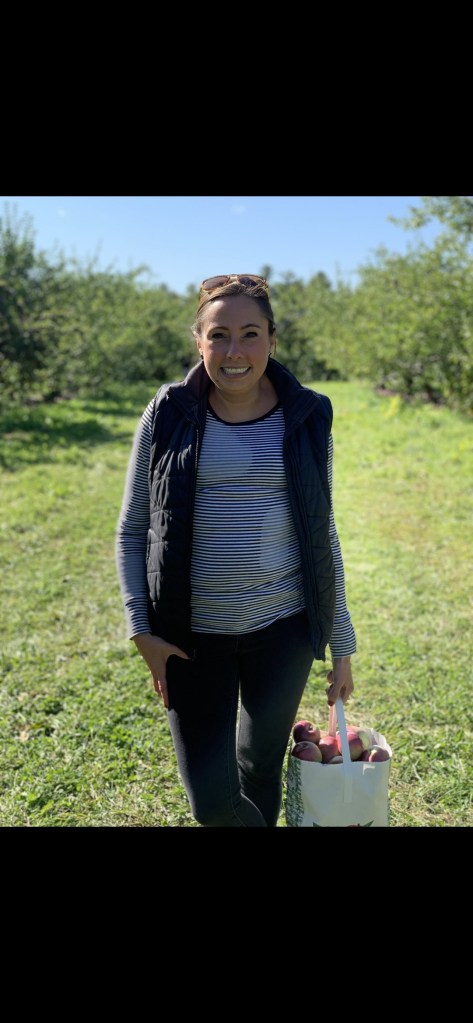
Jamielynn Brydalski is an internationally award-winning mixologist. She travels the world but met Sharon while bartending in Lake Placid, New York. More than 20 of her recipes are featured in the book.




 SharonsSuperSecretEdenBlog
Written
on September 19, 2020